Did all of this happen in 18 minutes?
The 25 minutes between Narin Güran’s last appearance on the school camera at 15:15 and Nevzat Bahtiyar’s red car arriving at the riverbed at 15:40 — minus the seven-minute drive from village to riverbed — leaves 18 minutes. An analysis questioning how the fantastic scenarios produced by the media could possibly fit into that window.
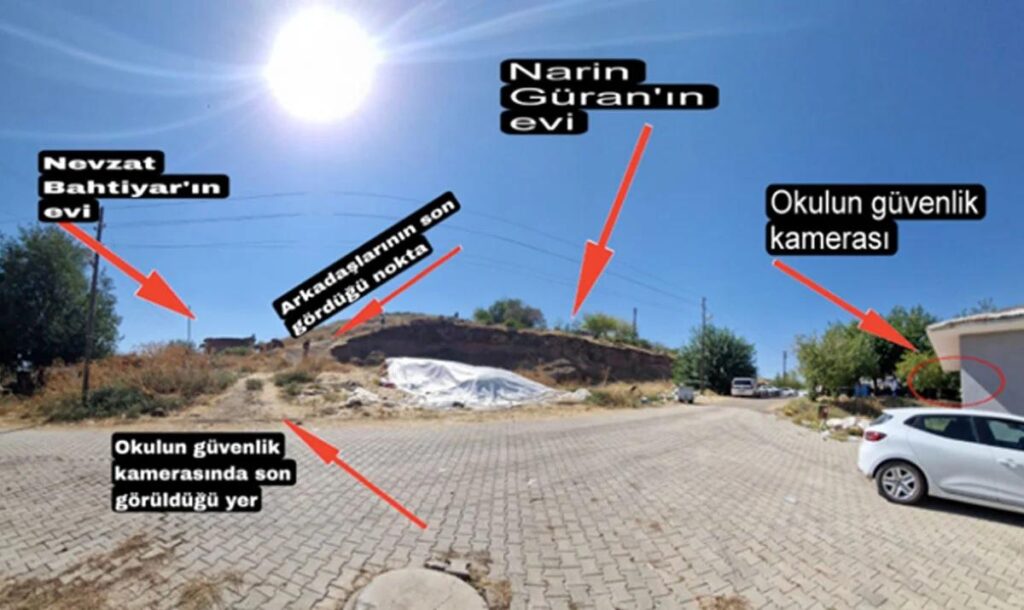
Narin’s final image walking from the mosque toward home is at 15:15. Nevzat Bahtiyar’s red vehicle arrives at the riverbed at 15:40. So whatever happened, happened in those 25 minutes. If you also subtract the road from the village to the river, it’s 18 minutes. Even just reading aloud the dialogues from the statements given by Bahtiyar — who turned witness when he was caught — takes three minutes. So how is it that the confessions of the only person in the village clearly involved in the murder, who calmly recounts a horrific crime, ended up as the chief reference for the gendarmerie and the media?
“The recording that will solve the murder is on Halk TV”
Under a breaking-news bulletin, the reporter speaks excitedly from Tavşantepe village:
“Salim Güran has a phone call with R… A… shortly after Narin’s disappearance at 15:15. In that call he asks the following — in the audio recording obtained from R… A…‘s phone: ’R…, is the girl alive or dead?’ Let me repeat: ‘R…, is the girl alive or dead?’”
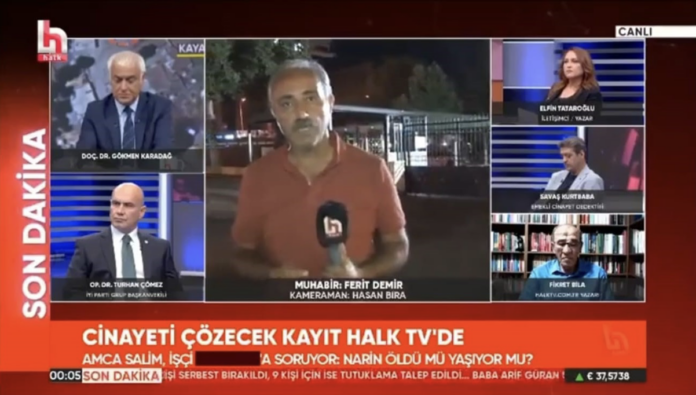
While he speaks, he doesn’t say “R.A.” He says the full name.
Yet the person referred to is a 15-year-old farm worker.
If true, this would be a phone call amounting to a confession of the murder.
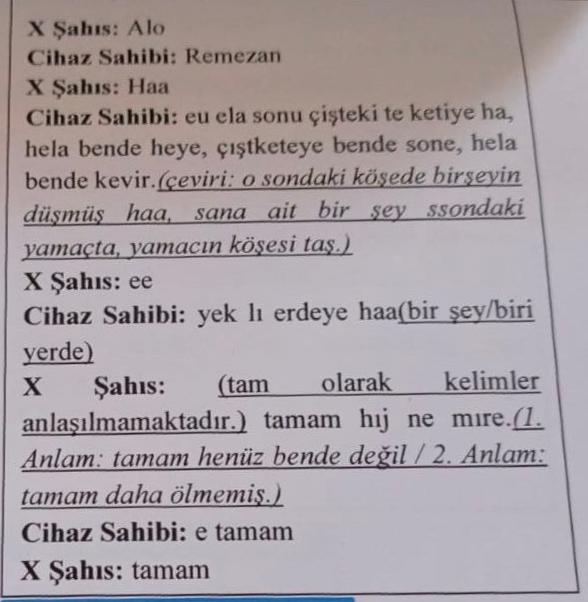
The next day the transcript was published of the recorded telephone conversation between uncle Salim Güran — the media’s prime suspect — and his 15-year-old worker R.A.
The Kurdish-language conversation had been translated as follows:
Salim Güran: “At that corner at the end something of yours has fallen, ha — something belonging to you on the slope at the end, the corner of the slope, stone.”
R.A.: “Yeah.”
Salim Güran: “Someone is on the ground.”
R.A.: “OK, it’s not in my hand yet, it hasn’t died yet.”
These were disconnected, contextless sentences.
But there was no sentence in the transcript along the lines of “R…, is the girl alive or dead?” that Salim Güran had supposedly said the previous evening on Halk TV. There wasn’t even a sentence remotely similar.
In an earlier piece in this column we wrote that this disconnected “hasn’t died” sentence may also have been a translation error.
Following the doubts, the audio recording was listened to again, and a new translation of this important piece of evidence was produced.
Yesterday Anadolu Agency published a new transcript of this recorded phone call between Salim Güran and R.A.:
- 1. Male (R.A.): Hello (Hello)
- 2. Male (Salim Güran): R…
- 1. Male: Yes (Yes, hello)
- 2. Male: Toward the end something of yours has fallen, near your boundary, toward the end
- 1. Male: Hmm
- 2. Male: Near your boundary, something of yours
- 1. Male: OK, hmm
- 2. Male: Near your boundary, on the boundary, where the stones are
- 1. Male: Yeah
- 1. Male: Yes, it’s on the ground
- 2. Male: OK, I’ll go and pick it up now
- 1. Male: All right
- 2. Male: All right.
In the new transcript, there was no word like “hasn’t died.”
Indeed, there couldn’t have been.
Because this telephone conversation took place at 18:35, three hours after 15:40, when Nevzat Bahtiyar took Narin to bury her at the riverbed.
Even just someone aware of the timeline should have been able to guess that this conversation could have nothing to do with the murder.
In his statement, Salim Güran had also accounted for this conversation, even making a confession of an offense:
“While irrigating the cornfield, I sometimes used a device to draw illegal electricity from the transformer. On the day of the incident I called R.A. so that he would pick up the device that I had left under a stone. The content of the conversation is entirely about that. It has nothing to do with Narin’s death.”
In short: the media had openly fabricated a tape.
The gendarmerie had translated and circulated a tape they were already suspicious about, incorrectly.
But this would not be the last fabrication.
Other false news stories
A few days later, another confident headline started circulating on Halk TV as breaking news:
“The Narin murder is being solved. Halk TV was right; the sister-in-law’s statement explains everything”
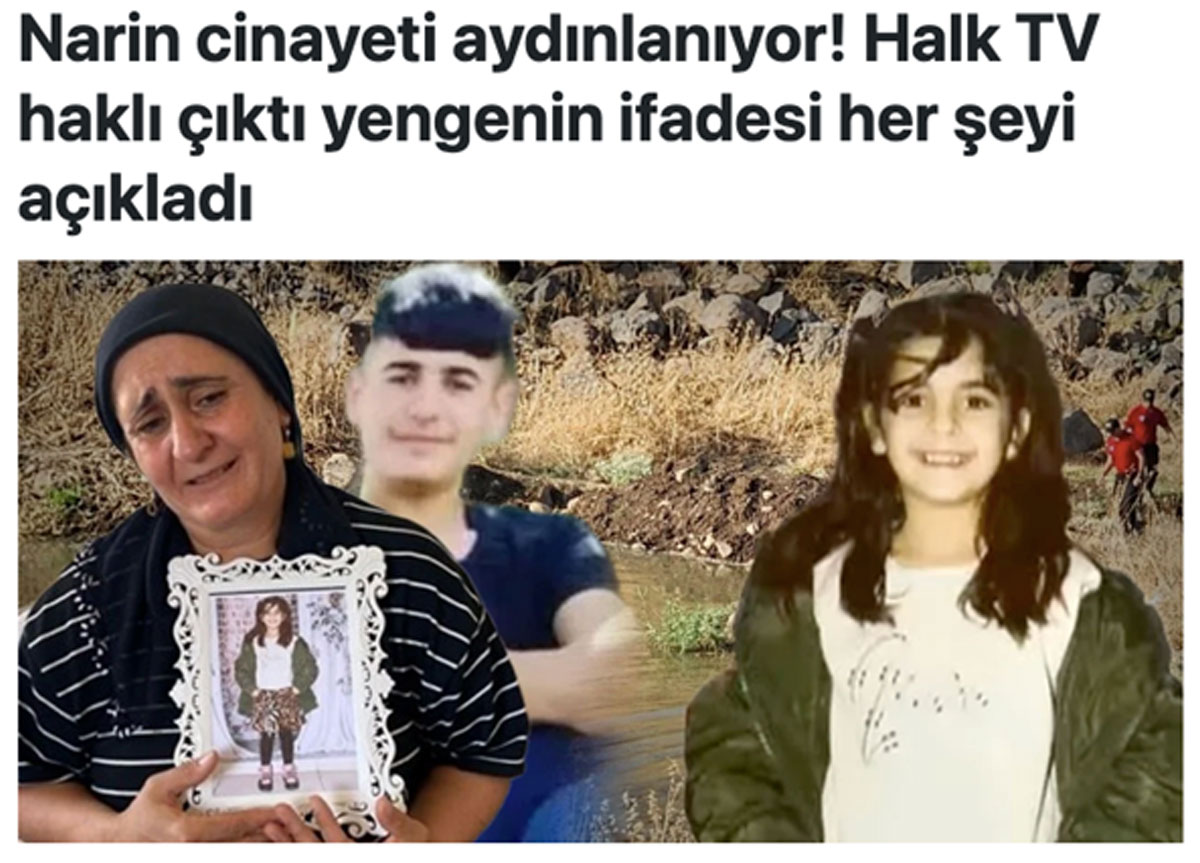
This selfish piece of news, drawing “vindication” out of a tragedy, soon began circulating in copy-paste form across the entire media:
“This statement will solve the murder,” “The knot is being untied,” “Someone has spoken.”
Hediye Güran was the wife of Narin’s uncle, the next-door neighbour. On the day of the incident, as on every other day, she had come to the Narins’ home.
Halk TV and the rest of the copy-paste media claimed that Güran had said the following in her statement:
“Sister-in-law Hediye Güran, who claims that Narin may have been killed in the barn, recounted that she saw mother Yüksel Güran beating her son Enes and a scuffle taking place between them.”
A theory was even built on top of this statement:
“Narin saw something. Upon this, she either screamed or reacted with something like ‘I’ll tell my father.’ To stop her from screaming, big brother Enes covered Narin’s mouth with one hand and pressed down on her neck with the other.”
The next day Hediye Güran’s statement came out.
It contained no barn, no scuffle, and no Enes.
This claim too had turned out to be a fabrication.
Like many other claims.
It had been alleged that the gas station attendant who claimed he had seen Narin wrapped in a blanket on the front passenger seat of Salim Güran’s car had given a statement and handed the camera footage over to the gendarmerie. The gas station attendant turned out to be a fake profile, no statement had been given, and there was no camera footage from the gas station.
But even seasoned police-beat reporters, without sitting down to look at the investigation file, wrote planned-family-murder theories based on this claim about killing a little girl.
Media and political prejudice
Despite repeated reporting that HDP came first in the village in 2015, İYİ Party came first in 2023, and DEM took more votes than Hüda Par in 2024; despite it being established that the village had no link to Hizbullah; despite it being known that allegations of secret weapons depots in the village were empty — these facts did not stop the DEM Co-Chair from repeating the ideological clichés in his head.
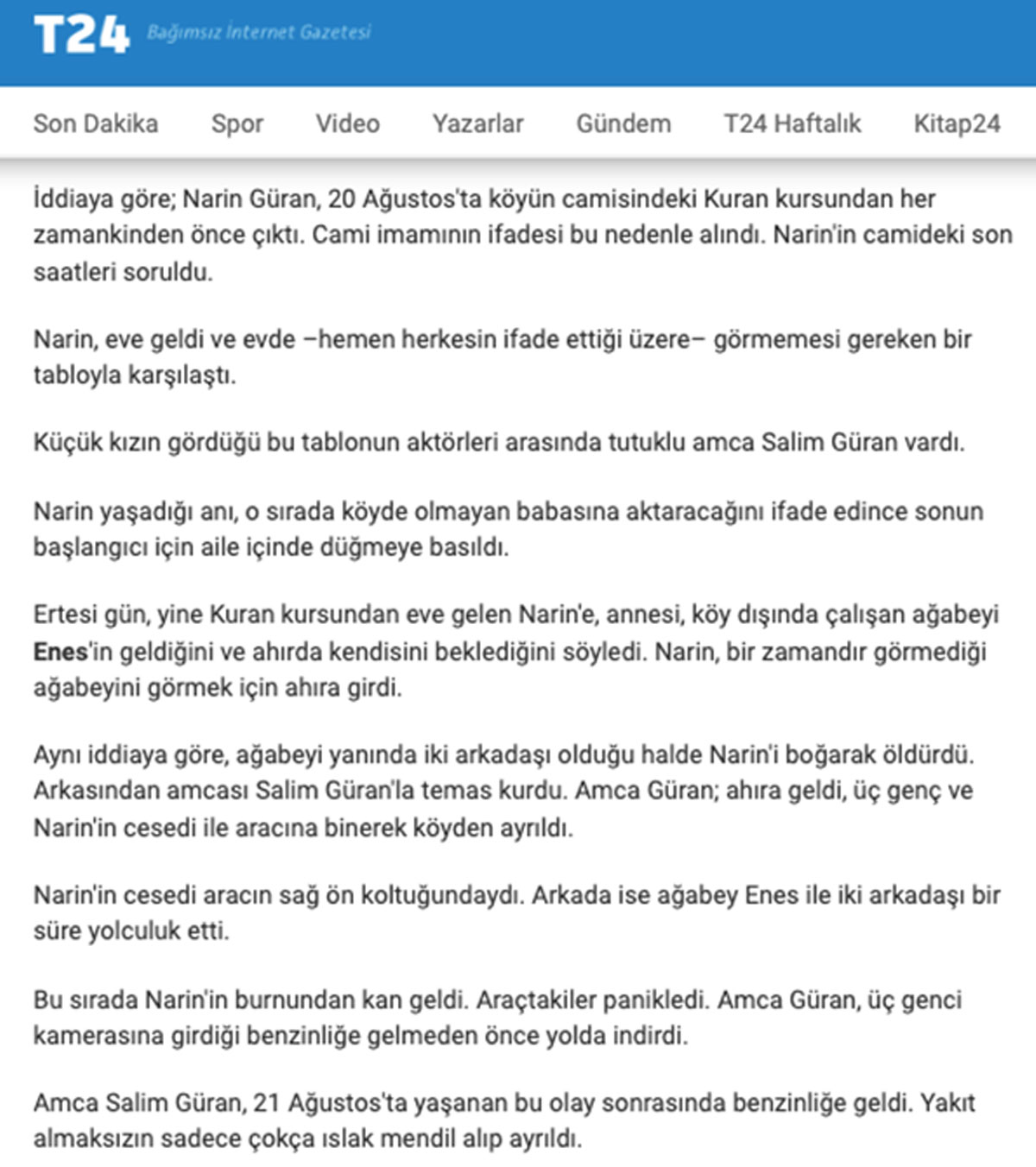
The claim that Narin had been killed by paramilitary forces was as ridiculous as the claim that the murder had been committed by a secret cult ritual.
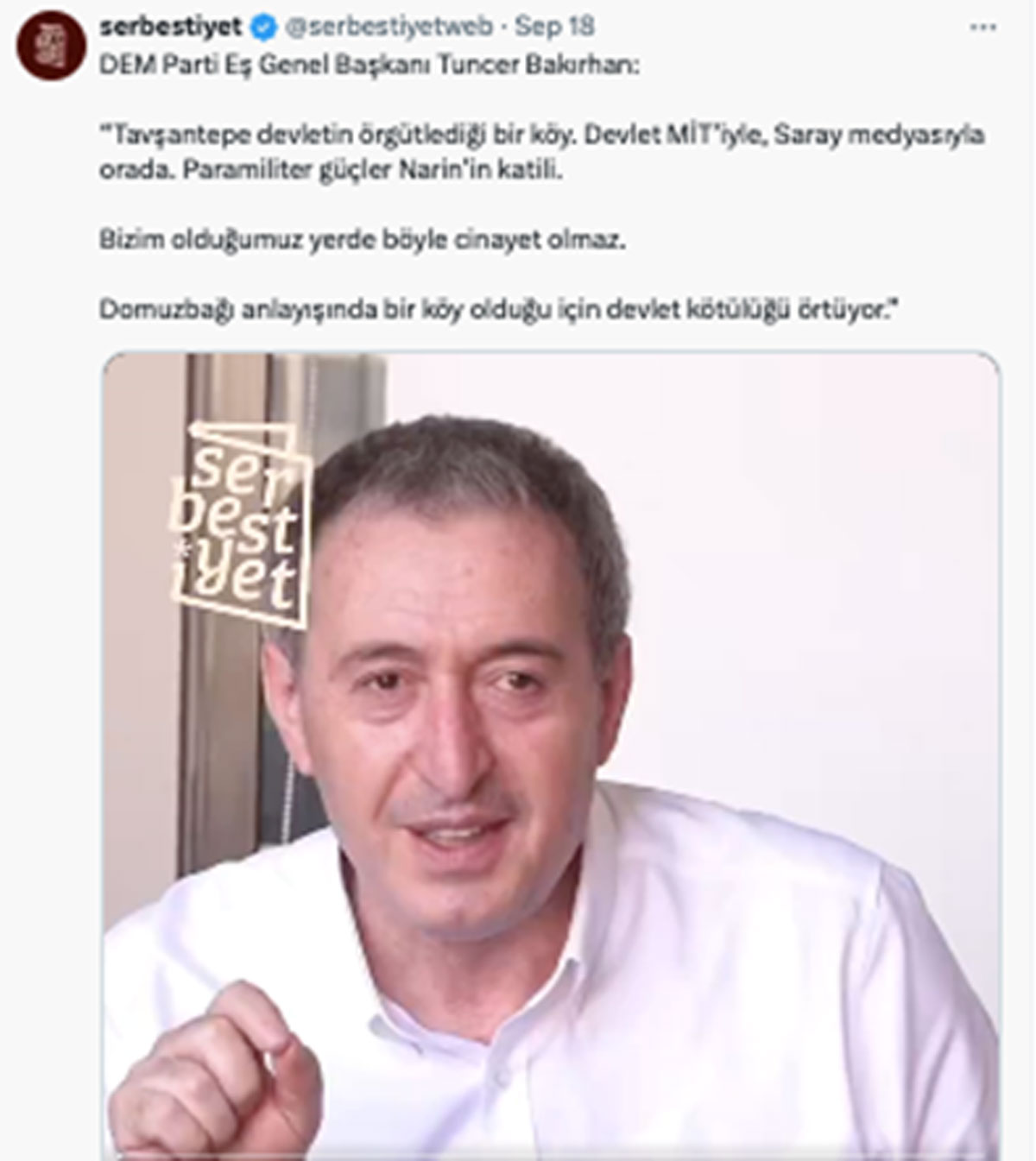
But the alliance of prejudice — bringing AHaber, Halk TV, and the DEM Party together for different reasons — had blinded everyone.
Simple truths: 18 minutes
About the demonic “Omerta Village” — said to gather in family councils at night to set the next day’s statements, to raise the river’s flow rate so the body wouldn’t be found, to cut off the electricity, to stop using mobile phones, to mislead the gendarmerie with false tip-offs so the body wouldn’t be found, to be sterner under interrogation than İbrahim Kaypakkaya in giving away nothing — and about a family and a village allegedly united to kill an eight-year-old girl and conceal the murder, you could say absolutely anything you wanted.
Nobody sat down to ask whether any of it could be true.
Yet there was no Omerta to begin with. In their statements, family members and villagers had said many things against one another.
The mukhtar’s wife said she suspected her husband; Narin’s older brother spoke of the closeness between his uncle, the mukhtar Salim, and Nevzat, and described Nevzat as a downtrodden man who would do anything for money; the mother said that Narin and the uncle had got into the back seat, not the front — putting the uncle, the mukhtar, in a difficult position with respect to the DNA found earlier on the front seat.
But in this murder case that for days, in main news bulletins, had turned into a Müge Anlı show, anything that came along under headlines such as “Spine-chilling claim,” “Devilish plot,” “They’ve done this too” went straight on air.
Senior journalists, for the sake of a few extra clicks, didn’t shy away from publishing — naming names — sexual fantasies for which there was zero data and zero evidence, in answer to the question: “What did Narin see, that she was killed?”
Over the past 20 days or so, in this family everyone has been paired with everyone else, even with dogs.
- “She saw her uncle S. with his sister-in-law H. in the barn”
- “She saw her older brother and her cousins in a homosexual relationship”
- “She saw her older brother and her uncle in an incestuous relationship”
- “She saw her older brother with his sister-in-law in a relationship”
- “She saw her mother with her uncle in a relationship”
- “She saw her uncle, her mother, and her sister-in-law in a threesome”
- “She saw her older brother in a relationship with a dog”
The diagnosis of Diyarbakırlı master’s-degree student Miham Akkul, who has been following the Narin murder closely from France, is very apt regarding the contradictions in these claims:
“The media was generous when it came to grand sociological put-downs like honour killing, féodalité, and patriarchy; but paradoxically, they were also claiming that the village, knowing about the relationship between mother and uncle, had ignored this ‘dishonour,’ and that even the father and Enes had swallowed it and covered up the murder.”
Another disgrace was committed: turning a little girl who is the victim of a horrific crime into a hero of the village.
But this story had been sold to millions of people — clicks and praise were rolling in — and the crowd by now treated every possibility other than “the village that committed the murder and stayed silent” as political cover-up.
“What we have is a cacophony built for a month on baseless and contradictory claims, and inside this cacophony a vast public dazed enough to be convinced of anything.”
The time calculation
A DHA reporter did very good work and drove the roughly two-kilometre route from the village to the riverbed — partly asphalt, partly dirt — at 40 km/h, in seven minutes.
So another seven minutes are gone.
That leaves 18 minutes.
What’s more, these 18 minutes are the maximum possible duration, assuming that the disaster that befell Narin happened immediately after the moment she was last seen on cameras.
So what could fit into these 18 minutes?
It’s already clear that the gas-station-trip scenario — which turned out to be fake but which even seasoned police reporters still treat as if it were true — won’t fit.
But will the two contradictory statements of Nevzat Bahtiyar — who, when the fact that his car had gone to the riverbed was established, confessed under cross-examination that he had buried Narin — fit into 18 minutes?
Nevzat Bahtiyar’s statements
When Nevzat Bahtiyar’s car was caught on a security camera at the riverbed, in his first statement to the gendarmerie under cross-examination he built on the gas station attendant’s claims (which had been circulating for days and later turned out to be fake) about the “body wrapped in a blanket on the front passenger seat.”
Salim Güran’s wrapping the body in a blanket and putting it in his car, going to a gas station, and then on the way meeting Nevzat without any reason — and all of that fitting into 18 minutes — does not look at all possible.
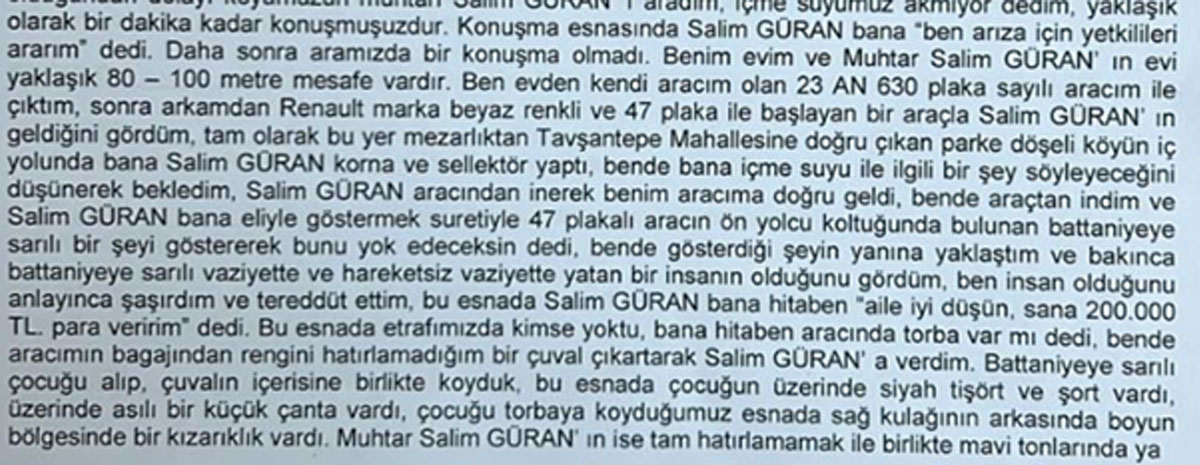
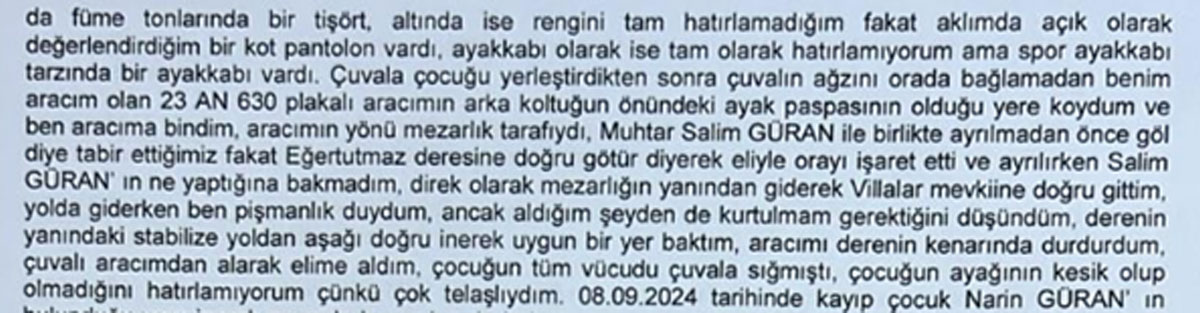
Nevzat Bahtiyar’s second statement, given to the prosecution, which he said is “my real statement,” contradicts the first and is even more detailed.
He took the body from Salim Güran, brought it home, found a sack, put the body inside…
You decide whether all of this could fit into 18 minutes:
“Salim Güran called from the garden of Arif Güran’s residence, 100 metres from my own. He said he had business with me, that he would come by car, that I should get ready. I stopped watering the trees and waited. He arrived a few minutes later. He said, ‘Get into your car and follow me.’ I started following with my son’s car. We stopped 50 metres away on the road that leads to the cemetery. When Güran rolled down his right front window, I saw on the front passenger seat the blanket in which the child was wrapped. When Güran got out of the car, I got out too. Pointing to the blanket, he said, ‘I killed Arif’s daughter.’”
Forget the actions in the statement; even just reading the dialogues aloud takes 3 minutes.
That leaves 15 minutes.
All these actions would have to take place within those 15 minutes.
Of course, only if we accept that Narin was killed immediately after she entered the path.
Is this possible?
What if not?
Questions
What if Nevzat Bahtiyar — who owned the other house on Narin’s path home from the mosque, who by his own statement was definitely at home that day watering the trees in his garden, whose two statements obviously contradict each other, who calmly recounts a horrific crime — what if this man, who in the media has practically been treated as having helped uncover the truth and as a witness on whom the Güran family is trying to push their guilt, is lying?
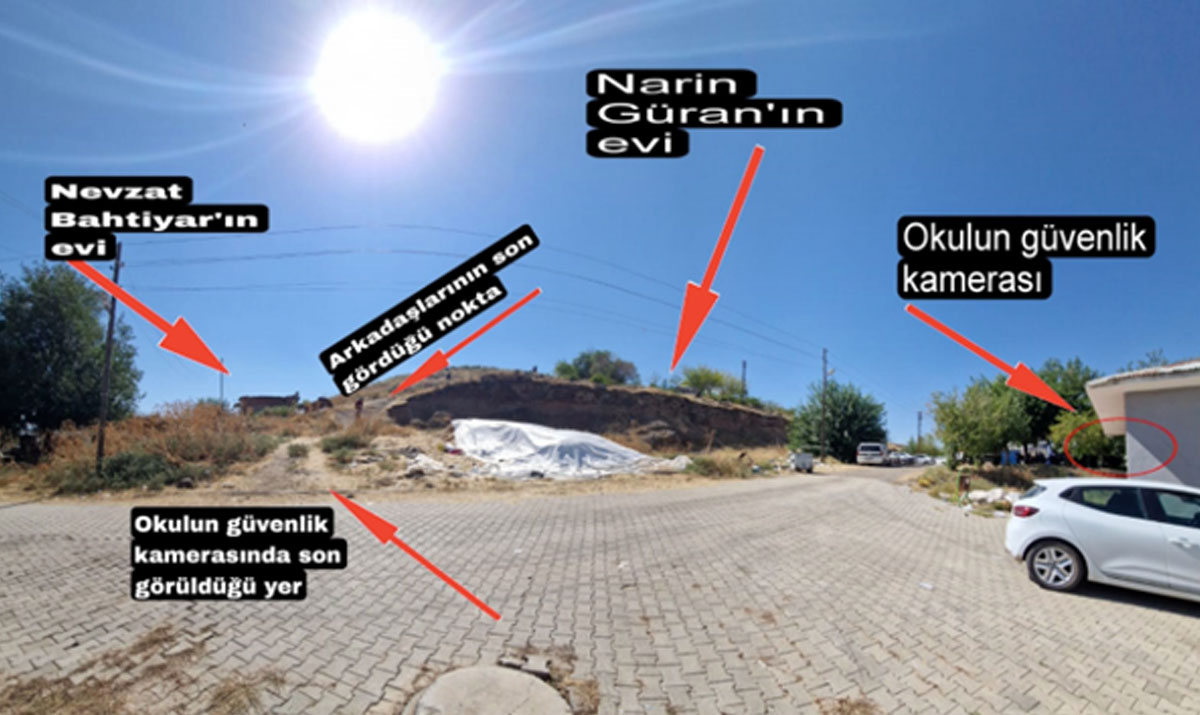
How is it that the gendarmerie and the media took as their chief reference the cross-examination confessions of this miserable man — who, in his own words, “either out of fear or for 200,000 lira” put a tiny girl’s body into a sack, tied the sack with the cord of her own school bag, and then placed 20-kilo rocks on top of it — the only person in the village who has definitely touched the body — only after he was caught on cameras?
How is it that the gendarmerie searched the home of a man who said “I brought the body to my home” only later?
While in the village almost the only ones not interrogated were the dogs — while even five- and six-year-old children were summoned to give statements on accusations of misleading the gendarmerie — why were Bahtiyar’s wife, mother, and children, with Bahtiyar himself saying “I brought the body home,” never asked what they saw at home that day?
What if the real murderer is the man who, when his car footage caught the riverbed visit, tried to escape by partially confessing?
What if the media, the politicians, the citizens — who have looked at this case from the start with prejudice and a desire to confirm their own theories — are with all these lies, claims, fantasies, and prejudices helping the killer cover up his crime?
What if the crime — every kind of crime, immorality, and silence — is not in these villagers but in the city dwellers who know everything so well, who are so moral and who talk so much?
The day this case is solved, we will learn a great deal not only about the murder, but also about Turkey.