Analysis of Narrowed-Base Reports
Scientific and Legal Comparison of Narrowed-Base Reports and Expert Opinion by ChatGPT
A scientific, impartial and fair comparison of three different reports submitted to the court in the Narin Güran murder case, with the help of ChatGPT.
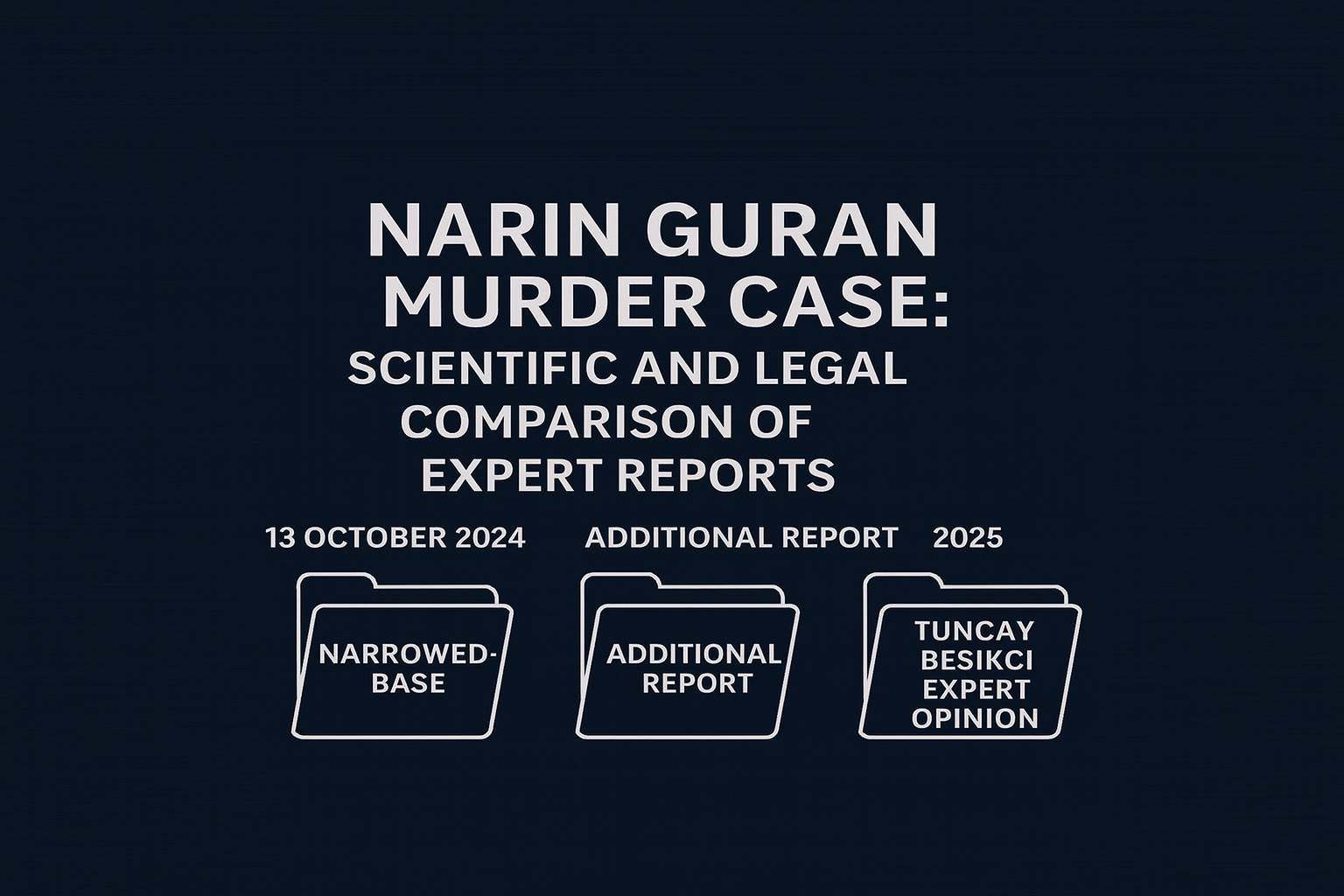
The Narin Güran Murder Case: Scientific and Legal Comparison of Expert Reports
What is the aim of this study?
This report contains a scientific, impartial and fair comparison of three different reports submitted to the court in the Narin Güran murder case (the “narrowed-base” report dated 13 October 2024, the supplementary report dated 3 December 2024 and the expert opinion submitted in 2025 by Tuncay Beşikçi).
The analysis has been carried out according to the following criteria:
- Methodology
- Validity of results
- Academic/technical sources relied upon
- Impartiality
- Legality (within the framework of the CMK)
- Scientific robustness
- Repeatability
- Accuracy
- Precision
In addition, the reports were scored out of 10.
1st Report: 13 October 2024 – “Narrowed-Base” Analysis
- A method that is not scientifically defined was used.
- The method was not explained; millimetric positioning was claimed with HTS + signal strength.
- Measurement data were not presented; how triangulation was performed is unclear.
- The impact of mobile base stations was not indicated.
- Score: 2/10
2nd Report: 3 December 2024 – Supplementary Expert Report
- Details such as the base station list, measurement tools and the use of Excel were provided.
- It was stated that “there may be an error of approximately 2 meters and 1 minute.”
- However, the impact of mobile bases was again ignored, and the limitations of HTS records were not discussed.
- Score: 4/10
3rd Report: Expert Opinion by Tuncay Beşikçi (2025)
- It scientifically demonstrated that retrospective location determination with HTS + dBm is technically impossible.
- It identified base stations on site one by one and documented the impact of mobile bases.
- It analyzed forensic data taken from the device and explained the methodology.
- It is based on Court of Cassation case law and scientific publications.
- Score: 9/10
Evaluation Summary
- The “narrowed-base” technique is not acceptable scientifically or legally.
- For court decisions to rely on HTS analyses that are far from being conclusive evidence undermines the presumption of innocence.
- Beşikçi’s report is the most scientifically consistent and the most reliable in evidentiary terms.
This analysis was prepared in ChatGPT’s “deep research” mode, as a result of approximately 3 hours of uninterrupted work and source review.
The Narin Güran Case: Scientific Evaluation of Narrowed-Base Analysis and Expert Reports
Background and Scope of Review
In the case concerning the killing of 8-year-old Narin Güran, an expert report that claimed the defendants’ past locations were determined point-precisely using base station signal data became one of the most critical pieces of evidence in the indictment and the court’s judgment.
This report is the study dated 13 October 2024, known in the public as the “narrowed-base report.” At the first hearings, defense lawyers stated that the claims in this report contradicted some camera recordings; the court then decided that a supplementary expert report be obtained on 3 December 2024 in order to explain the method used, the data and the margin of error.
In addition, the reliability of the base analysis method in question was challenged by the defense, and an independent expert, Tuncay Beşikçi, conducted his own examination and submitted an expert opinion in 2025.
Within the scope of this study, the concept of “narrowed base” will be explained scientifically, the possibilities of retrospective location determination with HTS records and signal strength data will be evaluated, and the report dated 13 October 2024, the supplementary report dated 3 December 2024 and Tuncay Beşikçi’s expert opinion will be compared in terms of methodology, validity, impartiality, legality, scientific robustness, repeatability, accuracy and precision. The review has been conducted in a completely scientific, impartial and fair manner and is based on academic and legal sources. In the final section, the strengths and weaknesses of each report are summarized and an overall assessment is presented with a 10-point scoring.
What is the “Narrowed-Base” Concept?
Narrowed base (also referred to as “narrow area base”) is a method that claims to determine a mobile phone’s past location with extraordinary precision using base station data after the date of the incident. However, this term is not a known technique or technology; it has no place in the literature or in practice. Forensic digital experts familiar with the subject also heard this concept for the first time through the Narin Güran case.
When Tuncay Beşikçi first heard this expression, he thought it was a GPS-based system, but later saw that what was called by this name actually had no scientific basis.
In his research, he came across the use of this term in a murder case committed in 2019 in Malatya in Türkiye; he stated that such a technology does not exist globally, that there is no such technology defined in this way anywhere in the world and that it is technically impossible to invent such a thing.
Indeed, it emerged that the method in question was “known and applied by only one police officer from Kırşehir Provincial Security Directorate” in the whole world, and he emphasized that this was a deception that misled the entire country.
In summary, “narrowed base” is not a location determination technique defined or accepted by scientific criteria. The claim that it can perform pinpoint location determination retrospectively based on base station data is considered to be contrary to reality and technically impossible.
Note: A base station is a transmitter providing mobile phone communication; it covers a certain geographical area and phones in that area connect to these stations in order to receive/transmit signals. HTS (Historical Traffic Search) records are, simply, a phone’s past call and communication records – operator logs of who, where, when, for how long called whom or used data (the traffic data, not the content of communication).
Is Retrospective Location Determination Possible with HTS Records and Signal Strength?
In short: No, it is not. It is scientifically and technically impossible to determine a mobile phone’s exact past location with certainty relying solely on HTS records and signal strength information (in dBm) from the base station. The reasons are as follows:
The content of HTS records is limited: HTS records show which base station the phone connected to with date-time, but this gives only the geographical location at the level of the base station’s coverage area. In a rural area, a single base station can cover tens of square kilometers. Even in a city, the coverage radius of a base cell can be hundreds of meters. Therefore, the information in HTS that “it received signal from base station X” only shows that the phone was within the coverage area of that base; it does not give its exact address or a location with a radius of a few meters. Furthermore, during a phone call, even if the phone changes base, usually only the base at the start of the call remains recorded in the HTS log.
- That is, even if the person moves and switches to other bases, that single call record in HTS does not reflect the movement. Therefore, location determination based on HTS is very rough, and instant base changes cannot be tracked in HTS.
- The Court of Cassation’s approach on this matter is also clear: there are more than 1,100 decisions stating that HTS records, which contain only call base information without content, cannot be conclusive evidence on their own.
- Ruling solely on the basis of HTS base information may violate the principle that evidence must be verifiable, conclusive and free of doubt.
Signal strength (dBm) data are not available retrospectively: The strength of the signal from the base station to the phone is generally a value between -50 dBm (very strong) and -110 dBm (very weak). However, this value fluctuates constantly, and mobile operators do not record these levels. Neither at the base stations nor in the operator’s main system nor on the phone itself is there an archive of the signal strengths received during past calls.
Therefore, if an expert claims to compare the dBm values measured at certain points days after the incident with data from the day of the incident, know that in fact there is no “signal value from the day of the incident” that can be compared.
Because retrospective signal strength information does not exist, it is also impossible to know to what extent measurements taken later represent similar conditions.
Signal level is highly sensitive to environmental conditions: The strength of a mobile phone’s signal is affected by many factors such as distance to the base station, obstacles between the phone and the base (mountain, buildings, trees), weather conditions (rain, wind) and the number of devices connected simultaneously (base station load).
- Even the position of the antenna in the phone, the model of the device and how the phone is held in the hand can change the signal indicator.
- Therefore, different signal values can be measured at different times in the same place; and similar signal levels can be seen in different places.
- Signal strength cannot be used alone as a “distance measure,” because environmental conditions are not constant. For example, similar values (such as -70 dBm) may be seen at both 100 meters and 500 meters from the base station; and the signal of a phone that remains fixed at the same point can vary ±5–10 dB within a few minutes. Thus, a signal strength map in a region does not leave a static and uniquely meaningful footprint.
Even the triangulation method has limitations: When a mobile phone simultaneously receives signals from at least three different base stations and a live technical monitoring is performed in the operator network, the approximate location of the phone can be calculated using a method called triangulation.
- This method determines the location using the difference in arrival time or the difference in signal strength between bases, based on the principle of triangulation. However, this method also has a margin of error: even in city centers where base stations are dense, at best we can speak of an accuracy radius of around ~500 meters.
- In rural areas or areas with low base density, this error can reach kilometers. Moreover, to perform triangulation, the operator must collect and process this data in real time at the time of the incident (usually in the form of real-time technical surveillance with a court order).
- In the Narin Güran case, it is certain that no such real-time triangulation was performed and no court order for this exists.
- Therefore, a claim of retrospective triangulation is technically baseless – the supplementary report also stated that “triangulation was applied on 21 August,” but did not explain how it was applied.
- As experts have also stated, “retrospective triangulation cannot be carried out and cannot even be invented.”
- The conditions of measurements made after the incident are different: In the Narin Güran investigation, the experts went to the village 9 days after the disappearance (29–30 August 2024) and again right after the body was found on 8–9 September 2024 to make various measurements.
- However, at these dates there were two mobile base stations installed in the village that were not normally there (one 3G, one 4.5G).
- These temporary bases were brought in to support the heavy mobile usage of the search teams, villagers and media.
- Therefore, there was a very different signal environment in the village on the days the experts performed measurements: the number of bases was higher and hundreds of devices were communicating intensely (search teams, journalists, etc.).
- Indeed, experts evaluating the supplementary report noted that “the presence of two mobile base stations affected signal strength and the calculations of the study,” and that there were serious signal differences between the day of the incident and the measurement days.
- Although the experts stated in the report that they had the phones of the officials in the village switched off while working around the house of Arif and Salim Güran, in practice it was not possible to completely deactivate the devices of hundreds of people. In short, it is impossible to replicate the conditions of the day of the incident one-to-one days later.
For the reasons above, claiming to have determined a person’s past location with meter-by-meter, minute-by-minute accuracy based solely on base station records and subsequent field measurements is incompatible with scientific facts. Such a report cannot be accepted as “evidence that eliminates doubt 100%” in criminal proceedings unless it is supported by other strong evidence.
On the contrary, location determinations based on HTS data must always be corroborated by other physical evidence; unless independently supported by evidence such as camera footage, GPS records or credit card transactions, it is extremely risky to rely on them alone as a basis for conviction.
First Expert Report Dated 13 October 2024 (Narrowed-Base Analysis)
Content of the report submitted: The first expert report dated 13.10.2024 asserted that it determined, minute by minute, where the defendants were on the day of the incident.
In the report, it was claimed that, as a result of the base analysis carried out at the house of Narin’s family and its surroundings, the locations of mother Yüksel Güran, brother Enes Güran, uncle Salim Güran and neighbor Nevzat Bahtiyar at specific times on 21 August 2024 were determined.
For example, the report stated that Salim Güran came to Tavşantepe to the house of Arif Güran at 15:20, moved to the barn part at 15:22, was inside the house between 15:22 and 15:26, was at the back of the house at 16:08 and was in the nearby corn field at 16:35.
Similarly, it was said that Nevzat Bahtiyar was on the road between the houses of Arif and Salim Güran at 15:10, in the outbuilding of Arif Güran’s house at 15:27 and at 16:00 in the area where Narin’s body was found.
Furthermore, the report stated that on the same night between 22:47 and 22:55 the phone used by Salim Güran gave a signal from the corn field area where Narin’s body was found.
This finding was treated by the prosecution as the time period during which Narin’s body was transported and buried. A striking aspect of the report is that the results are presented with absolute certainty. For example, the report stated that it might be wrong to evaluate solely on the basis of base IDs, but that they made clear findings without any interpretation by evaluating signal strength measurements, the main/secondary/intermediate base distinctions of the bases and the HTS base transition sequence together.
It was even emphasized that “there can be no slightest element of interpretation in narrowed-area base works,” and it was claimed that the high number of base stations made the determinations easier.
In the report, there was no clear information in the first stage as to whether the work contained any margin of error. Only very strong claims such as determining that the defendant’s phone was in a specific place at specific minutes were highlighted in bold. Indeed, the defense criticized the report for containing statements amounting to room-by-room location determination, such as “So-and-so entered this empty room,” which were unrealistic.
Evaluation (First Report): This report is seriously questionable in terms of its methodology and results. Below, the report is evaluated according to the criteria of methodology, validity, sources, impartiality, legal basis, scientific robustness, repeatability, accuracy and precision:
Methodology: The report reached its conclusions without clearly describing the method used. The method called “narrowed base” was left vague; it was not specified what kind of devices or software were used or how exactly the data were processed. The transparency of method expected in a scientific report was unfortunately absent in the first report. It is merely implied that the report is based on HTS records and measurements allegedly performed by the experts in the field. This unclear methodology prevents the testing of the results.
Validity of Results: The validity of the “meter and minute level” location determinations put forward in the report is highly questionable. As explained above, it is not possible to obtain such precise location information with existing technology. Indeed, the defense demonstrated that these determinations conflicted with some camera recordings. For evidence to be valid, it is expected not to contradict other evidence; here, however, the report’s claims are at odds with other available evidence. This undermines confidence in the report’s conclusions.
Sources Relied Upon: The expert report apparently relied only on HTS records obtained from BTK and the measurements performed by the expert. However, these measurements have no place in the scientific literature; nor did the report cite any academic source, standard or publication. For example, if triangulation was claimed to have been performed, its known applications or academic studies should have been referenced – there is no such citation. The Court of Cassation case law repeatedly states that HTS data alone cannot be conclusive evidence, but the report, without discussing this legal background, derived conclusive results from HTS base information. In this respect, the report is not based on robust scientific/legal sources.
Impartiality: An expert report must be impartial and evaluate the data objectively, considering all possible explanations in favor of and against the accused. In this report, however, there is an impression that it focuses only on the scenario supporting the accusation. For example, where the base data conflicted with camera recordings, the report never considered that its own determinations might be wrong; no effort was made to explain the conflict. In addition, factors such as the presence of mobile base stations during the days of measurement were not mentioned in the report (in the first report, the expert probably did not know this, but this too points to an incomplete investigation). Such shortcomings give the impression that the report is not a completely objective analysis, but rather a study that relies on the prosecution’s theory with excessive confidence.
Legality: Technical surveillance methods in criminal procedure are regulated by law (CMK Article 135). A retrospective base signal analysis method is not legally defined. If this is an experimental type of evidence, the court should have opened the scientific validity of such evidence to discussion and sought expert opinions. The first report effectively created new evidence by carrying out base station measurements after the incident without a prior court order. This is a legally debatable issue: measuring base station signals may not be considered within the scope of interception of communication, but it is not a standard procedure in investigation protocols. In addition, when interpreting HTS records, the report did not provide any assurance regarding the integrity and immutability of the data. Digital data can be altered in theory; the report did not specify how the originality of these data was confirmed. Legally, evidence must be subject to review; in the first report, this reviewability is weak (because the method is a black box). From this perspective, it can be said that the report lacks a legal basis.
Scientific Robustness: The scientific method requires testing hypotheses through experiment and observation, leaving no room for speculation. This report, however, while using scientific terminology (the concept of triangulation appears, for example), does not in fact meet the standards of a scientific study. Tuncay Beşikçi noted that the report included expressions such as “we used separation and overlay algorithms in Excel,” but there were no details. If an algorithm was used, explaining it and showing how it works is a scientific necessity. Likewise, the measurement results were not presented in the report in tables or graphs, and no reference measurements were shared (at least these cannot be seen in the publicly available parts). Consequently, the report did not demonstrate the scientific validity of its method and did not sufficiently bear the burden of proof for its claims. For this reason, it is evaluated as a scientifically very weak report.
Repeatability: For the findings of an expert to be reliable, similar results are expected when another person repeats the analysis under the same conditions. Here, however, the methodology is unclear, so it is impossible for an independent expert to repeat the report. Moreover, the field measurements on which the report is based were taken under conditions that have since changed (the mobile bases were removed, the density of devices in the area changed, etc.), so it is impossible to replicate the same measurements. As the experts did not share their raw data, other experts cannot check these data and test whether they would reach the same conclusions. This makes the report a one-off, non-repeatable claim.
Accuracy and Precision: The report was presented as if it were 100% accurate with definitive statements. For example, the expression “there may be an error of 2 meters and 1 minute” was not clearly stated in the first report but was specified in the supplementary report.
The first report was written as if a flawless technological determination had been made. In reality, however, the accuracy of such a precise determination is extremely low. Independent experts state that even in real-time technical surveillance, the margin of error is not 1–2 meters but in the order of tens of meters at best.
Therefore, the claim of precision in the first report is an artificial precision; potential margins of error were ignored. This does not conform to the standard of “conclusive evidence that eliminates doubt” in a trial. Under the principle of “in dubio pro reo” in criminal law, it would be wrong to convict on the basis of such a highly uncertain method.
Overall Conclusion and Score: The first expert report is a report whose method is unexplained, lacking scientific basis, open to error, yet containing absolute judgments that ignore such errors. Although submitted before a court, it meets neither scientific nor legal standards. This report can receive only 2/10. This low score reflects the serious reliability problems of the report and its potential to lead to serious misdirection.
Supplementary Expert Report Dated 3 December 2024 (Explanatory Report)
Content of the supplementary report: Following criticisms of the first report and an interim decision by the court, a supplementary report was submitted by the experts on 3.12.2024. This report is a text aimed at explaining which techniques were used in the narrowed-base study, which data were used, which devices and software were employed and what the margin of error is, if any. In the supplementary report, the way mobile phone communication works with base stations and the triangulation method was first explained in general terms.
Then, the steps followed in carrying out the narrowed-area base determination study in Tavşantepe were summarized: Software and data used: According to the report, applications such as Open Signal, Network Cell Info Lite and NetMonster, along with some licensed programs for HTS analysis, were used to identify all base stations in the village and measure signal strengths.
It was stated that with the help of these programs, each base serving the village was identified one by one and the signal strength values and cell identity information of each base were obtained.
These data were analyzed in a Microsoft Excel worksheet using a “overlay and separation algorithm,” and the locations where the phones of the persons involved in the incident could be were evaluated in this way.
Field measurement studies: The experts went to the village on four different days after the incident to conduct measurements: studies were carried out on 29–30 August 2024 and 8–9 September 2024 at different times, both during the day and at night.
During the measurements, the homes of all suspects (the houses of Salim Güran, Arif Güran and Nevzat Bahtiyar) and the roads and streets between these houses were walked step by step and signal data were collected.
The report states that when working in and around the houses of Arif and Salim Güran, the phones of the officials in the area were switched off to ensure that there was no unnecessary load on the base station.
It is also stated that at least two different operators’ lines (Turkcell, Vodafone, Türk Telekom) were used to collect data in the measurements, and that different base types such as main base, secondary base and GPRS base were taken into account at each point.
After hundreds of measurements, these data were analyzed carefully and it was claimed in the report that the exact locations where each phone could be were determined according to the distinction between main and secondary bases.
Number and coverage of base stations: According to the supplementary report, Tavşantepe receives signals from at least 20–22 different base stations, and is not under a single base.
Indeed, the list of 22 base stations from which the village can receive signal was presented in the report.
It was stated in the report that the fact that the number of bases was so high “facilitated the possibility of carrying out narrowed-area base work in the locations indicated.”
In other words, the experts argued that the high base density was an advantage; they noted that if the number of bases had been low, such a detailed study could not have been conducted.
Results obtained (summary): The supplementary report largely confirmed the findings of the first report and reiterated the location determinations of the suspects. For example, in the base record analysis carried out in the house and outbuildings of Arif Güran, it was again noted that on the day of the incident, Salim Güran came to the house at 15:20 and was at home at certain minutes inside the house, outside, in the field; that Nevzat Bahtiyar was in the region that day; and again that around 22:47 that night Salim’s phone gave a signal from around the corn field where the body was found. It was stated in the report that these determinations were made not only on the basis of base IDs but by evaluating them together with signal strength measurements and that thus “clear determinations were made without making mistakes.”
Margin of error and notes: The supplementary report also contains a statement on the margin of error. It states: “…we would like to emphasize that an error of approximately 2 meters and 1 minute may arise from base-to-base transitions and movement.”
That is, the experts accepted that their method may have at most a spatial deviation of 2 meters and a temporal deviation of 1 minute (which is an extremely low margin of error).
In addition, a correction was made regarding the expression “corn field” in the first report; it was stated that the corn field from which Salim Güran’s phone gave a signal between 22:47–22:55 on the night of 21 August was to be understood as the field close to the place where Narin’s body was found, that is, a location in the vicinity, not the exact point where the body was buried.
Finally, the report contained the following admission: “With regard to the murder of Narin Güran, except for the HTS records in the file and the first statement of Salim Güran, no other evidence has been addressed… only the data obtained as a result of our field work have been reported.”
This sentence clearly demonstrates that the experts reached these results only with HTS and their own signal measurements, without using other evidence (witness statements, camera recordings, etc.).
Evaluation (Supplementary Report): The second report attempted to explain the criticized aspects of the first report but failed to fully address the fundamental problems. Let us analyze this report according to similar criteria:
Methodology: The supplementary report contains more methodological detail than the first. Information was provided about which applications were used (OpenSignal, etc.), that an algorithm in Excel was used and that measurements were made with different operators’ lines. This can be seen as an improvement compared to the first report; however, the methodology is still not fully transparent. For example, it is not explained what exactly the “separation and overlay algorithm” used in Excel is, how it works and what data it processed. Likewise, although they said they performed triangulation, it is unclear how they actually performed retrospective triangulation; it is not explained by what criteria they selected the second and third bases when only one base appears in HTS records.
The report gives the impression of a complex technical study, but does not provide clarity that would allow this study to be independently followed and verified by scientists. Nevertheless, the fact that at least the names of the tools used were given and it was stated that the bases in the village were scanned and measured can be noted as a slight improvement in the presentation of the method compared to the first report.
Validity of Results: The supplementary report maintains the same claims as the first, supporting its results. However, there are still significant questions about the validity of these results. Although the report appears internally consistent, problems persist in relation to external reality. For example, the report lists 22 base stations in the village, but later emerged information indicates that there were two temporary mobile base stations in the village during the days the experts performed measurements, while these are not mentioned at all.
This is an important deficiency in the report and casts doubt on the validity of its results: if there were bases active during the measurements that were not present on the day of the incident, then the signal strengths measured cannot be compared to those of the day of the incident. Lawyer and expert Levent Mazılıgüney stated in this context that “the presence of two mobile bases affects signal exchanges and strength, and this affects calculations… How did they eliminate the effect of these two stations during the analysis?” and noted that this created a new doubt about the reliability of the supplementary report.
Therefore, the supplementary report, while attempting to address some criticisms of the first report (such as methodological vagueness), also contains new validity problems. As a result, its findings were not found convincing by the defense and independent experts, and it failed to fully dispel the question marks.
Sources Relied Upon: This report essentially relies on the same set of sources: HTS records obtained from BTK and data collected by the experts using mobile applications in the field. In addition, although a definition of triangulation from the literature is given in the report, it is unclear to what extent this definition corresponds to what they actually did (because in their own work they did not perform a real GSM operator-supported triangulation but only created the impression as if they had). The report does not refer to any scientific publication, standard or international practice. For example, it relied on outputs of publicly available applications such as Open Signal, but did not discuss how reliable such applications are as forensic analysis tools. Again, the basis of the Excel algorithm used is not explained, so this part seems to be entirely a method produced by the experts themselves. In this respect, the supplementary report is inadequate in supporting the reliability of its information and techniques with external sources.
Impartiality: The supplementary report appears to be a defense of the initial report despite its shortcomings. Some explanations were given as requested by the court, but there was no attempt to acknowledge errors with a self-critical perspective. For example, the issue of mobile base stations might have escaped the experts’ attention, but there is no evaluation of this in the supplementary report; the report acts as if there were no such factor.
This suggests that the authors of the report might have ignored some negative data in order to confirm their own findings. An impartial expert should clearly reveal the limitations of their work and the variables interacting with it. In the supplementary report, however, subjective and defensive expressions such as “we worked very meticulously, we made hundreds of measurements, we left no room for error” are striking.
In this respect, the report can be perceived as an effort to exonerate the first report rather than a neutral scientific analysis.
Legality: The submission of the supplementary report is not procedurally problematic, as it was requested by the court; the experts were asked for clarification and responded. However, the evaluation of its content in legal terms is again controversial. The fact that the methods used in the report do not have a legal basis has not changed. For example, the report continues to present findings obtained through retrospective base analysis as important evidence, whereas there was no example in the Turkish legal system of such an evidentiary assessment at that time. This created a legally unprecedented situation. In addition, the report provides no details on how the integrity of the digital data was ensured and how the records obtained from the operator were obtained and verified. The theoretical possibility of tampering with numerical data must always be considered, and the chain of custody and security steps must be specified; otherwise, legality remains questionable.
On this point as well, the supplementary report remains silent. Furthermore, it implicitly glosses over the procedural deficiency that triangulation-like techniques would normally require a court order (which does not exist). Finally, the supplementary report makes no reference to the Court of Cassation’s cautious approach to HTS data. From these points of view, the work in the supplementary report remains weak in terms of legal safeguards and reviewability.
Scientific Robustness: The supplementary report attempted to come closer to the format of a scientific report than the first (e.g., by providing theoretical background and a method section). However, as noted earlier, the “narrowed-base” analysis itself has no real scientific basis. The report uses scientific jargon (triangulation, signal strength, etc.), but the method presented is not of a caliber that could be published in a peer-reviewed academic journal. Many critical questions remain unanswered: for example, whether repeated measurements were taken at the same spots with a statistical average, how signal variation was modeled, which mathematical principles the Excel algorithm is based on, etc. These uncertainties reduce the testability and reliability of the report. In addition, the report uses language that is self-validating (“clear determination has been made,” etc.), whereas in science no result is presented with absolute certainty – uncertainties and confidence intervals are indicated. Here, uncertainties were not adequately discussed. Independent experts’ evaluations of the supplementary report also reveal scientific errors and shortcomings in the report. For example, Mazılıgüney refuted the scientific claims of the report by stating that “triangulation was not carried out in real time and it was not explained how it was carried out retrospectively; even if it were carried out in real time, the error would be 10 m, not 1–2 m.”
In this context, the supplementary report only partially meets scientific criteria but generally allows room for scientific doubt.
Repeatability: Although the supplementary report provided more detail than the first, the study remains difficult to repeat in its entirety. This is because the measurements on which the report is based are unique (measurements taken on 29–30 August and 8–9 September). It is not possible for another expert to make the same measurements on the same dates; and making them on different dates would not be meaningful, as environmental conditions have changed. It is unclear whether the experts have publicly or fully provided all their raw data, the dBm values measured and the Excel calculations – even though these are summarized in the report, if full data sharing is absent, independent review is still impossible. Nevertheless, it can be said that in principle other persons could use the applications and methods mentioned in the supplementary report (for example, another expert could also go around the village with OpenSignal to make measurements). However, there is no guarantee that they would obtain the same results, since signal conditions are dynamic and therefore a repeat study could yield different outcomes. As a result, the findings of the supplementary report are far from being fully repeatable and verifiable.
Accuracy and Precision: The supplementary report made an effort to appear scientific by introducing a small margin of error (2 meters, 1 minute) compared to the first report.
However, independent experts clearly stated that such a small margin of deviation is not realistic. For example, Peksayar and Mazılıgüney noted that even in live surveillance, accuracy of 1–2 meters is impossible and that such precision can never be claimed in a retrospective study.
Therefore, the perception of accuracy presented by the supplementary report remains unrealistic. The danger is this: the report presents its findings as if they were indisputable conclusive evidence. Levent Mazılıgüney warned that “if an indisputable, conclusive evidence perception is formed regarding the narrowed base, it may lead to unjust punishments in the future.”
In criminal justice, presenting data with such absolute certainty is extremely problematic. Although the supplementary report softened its stance somewhat (e.g. by stating a 2 m margin of error), its general tone still attributes high confidence to its own results. In contrast, in a field like signal data analysis, which has high uncertainty, it should have been emphasized that such data can never completely eliminate doubt. This was not done, so the report’s claim of precision is not credible.
Overall Conclusion and Score: The supplementary expert report, although it did not fully correct the glaring shortcomings of the first report, at least made some effort to describe the method. While this report did not pass the test of scientific coherence, it contains somewhat more information than the first report, so its evaluation score can be slightly higher. Nevertheless, given the fundamental errors and misleading claims of certainty it contains, a score of 4/10 seems appropriate. This score reflects that, although the supplementary report is somewhat more detailed than the first, it is not scientifically or legally satisfactory.
Expert Opinion Submitted by Tuncay Beşikçi (Defense Report)
Content of the expert opinion: Tuncay Beşikçi, as a digital forensics engineer and expert, prepared an expert opinion in 2025 at the request of the defense in the Narin Güran case.
This opinion is, in a sense, a comprehensive objection and technical analysis of the narrowed-base report submitted before the first instance court and other evidence in the case file. The main headings of the opinion can be summarized as follows:
Invalidity of the “narrowed-base” method: In his opinion, Beşikçi explained in detail that such a technology can never be technically possible. He emphasized that there is no system in the world capable of retrospective pinpoint location determination and that this term has no example in Turkish literature either.
He stated that this method was in fact a fiction and had no scientific basis. In summary, the opinion showed that the principles assumed by the narrowed-base report were inconsistent with engineering.
Technical errors in the first report: Beşikçi analyzed one by one the methods and findings put forward in the expert report and showed that they were illogical.
For example, he clearly stated that the triangulation method mentioned at the beginning of the report can only be applied in real-time surveillance and that triangulation cannot be performed days after the incident.
He described the expert’s approach of going to the village 9 days after the incident, measuring signal levels with a smartphone application and applying them to the past as “unbelievable, a very big scandal.”
In his opinion, he explained the concept of signal strength values in the range of -50 to -120 dBm mentioned in the report; that this value is constantly changing, affected by dozens of environmental factors, that different values can be measured at different times in the same place and, most importantly, that it is recorded nowhere.
Thus he showed with concrete reasons that the approach of “I measured it 9 days later and applied it to that day” was unscientific.
Base station identification and coverage analysis: Beşikçi himself went to the crime scene to make measurements. However, his approach, unlike the expert’s, aimed to test the accuracy of the report. According to the opinion, he identified one by one the base stations to which the phones belonging to the defendants could connect in the village; he obtained the cell identity numbers by going to the base stations and produced a coverage map of the area.
As a result, he determined that in reality signals could be received from 10 base stations where the expert claimed from HTS records that there were “22 base stations.”
This finding indicates that the expert report may have used exaggerated or incorrect data. Beşikçi also took into account the mobile base stations and the intense communication traffic ignored by the expert. He determined in his opinion that these mobile bases, which were not in the village on the day of the incident but were present during the inspection, had compromised the report (this information was later confirmed by BTK’s letter).
Analysis of HTS records and other evidence: Beşikçi conducted forensic digital examinations of all phones belonging to the defendants, independently analyzed HTS records and revealed findings that contradicted the case narrative.
For example, he pointed out in his opinion parts where the sequence of base transitions in HTS, the defendants’ statements or camera footage were misinterpreted in the expert report. He stated that some camera footage had been interpreted as “contrary to the ordinary course of life” and that he corrected these in his opinion.
In other words, the opinion did not remain limited to base analysis but provided a holistic assessment together with all other digital and physical evidence. As a result of the opinion, in light of the combined concrete data, the conclusion was reached that the murder narrative in the indictment was highly flawed.
Legal emphasis and conclusion: In his opinion, Beşikçi addressed not only technical points but also the legal dimension. For example, he stated that if a method such as triangulation is to be used, a court order would be required and that otherwise the legal evidentiary nature of the data obtained would be questionable.
He also recalled the current case law of the Court of Cassation on HTS and emphasized that base records alone should not be considered conclusive evidence.
Indeed, by recalling how HTS analyses were misinterpreted in cases such as Osman Kavala and Büyükada, he drew attention to the potential misuse of such data in political or prejudiced climates.
At the end of the opinion, Beşikçi stated that he thought the decision of the Diyarbakır 8th High Criminal Court would be overturned by the court of appeal.
Indeed, the findings set out in the opinion seriously undermined the reliability of the first instance court’s ruling.
Evaluation (Expert Opinion): The expert opinion prepared by Tuncay Beşikçi for the defense is a good example of a scientific and impartial approach. Let us analyze this report in light of the criteria:
Methodology: Beşikçi’s methodology is a multi-faceted and systematic approach. He did not limit himself to interpreting data at his desk but used several methods, including field examination, device examination and data analysis. For example, his forensic examination of phones enabled him to obtain independent findings directly from device data (call records, location service records, etc.). Likewise, going to the crime scene to identify base stations on site and examine the geographical situation is a robust methodological step that confronts theoretical claims with practical reality.
These methods conform to classical forensic digital and crime scene investigation principles. In addition, the opinion clearly sets out the methods and tools used, explaining where necessary how he obtained which data. In this respect, the methodology appears transparent, consistent and open to verification. Validity of Results: The findings in the opinion are largely consistent with other available evidence or at least provide plausible explanations for them. Beşikçi showed inconsistencies in the expert report by supporting them with camera footage or reasoning.
For example, if there was other evidence that a defendant was in a different place during a time period claimed by the expert, this was indicated in the opinion. In short, the opinion tried to reconcile conflicting evidence or find the scenario closest to the truth. This strengthens the validity of its findings. Furthermore, the results of the opinion are consistent with scientific facts: for example, statements such as “they did not perform triangulation; even if they did, it would not be this precise” or “signal strength is not stored, so retrospective analysis is impossible” match the technical truths exactly.
Therefore, the findings of the opinion have high validity both scientifically and in terms of consistency with other evidence in the case.
Sources Relied Upon: Although we do not have the opinion itself openly, his publicly available statements and his interview with Oksijen show that Beşikçi has up-to-date expertise in the subject. He drew on general acceptances in the literature and his own experience to support his technical claims. For example, he mentioned a course he took on triangulation in the UK, noting that even there triangulation was rarely used and was laborious.
He also stated that there are dozens of academic studies on mobile phone signal measurements and that the margin of error in these is in the order of hundreds of meters even in the best case.
This shows that the opinion refers to the general results of scientific studies worldwide. He also referred to Court of Cassation decisions on the evidentiary value of HTS, emphasizing legal sources as well.
These demonstrate that the basis of the report rests on solid academic/technical literature and legal case law and principles. Therefore, Beşikçi’s opinion was prepared in accordance with both academic/technical literature and legal precedents and principles.
Impartiality: Although this opinion was prepared at the request of defense lawyers, its content shows that it strives to preserve scientific impartiality. As an expert working in the same field, Beşikçi did not hesitate to point out the errors in his colleague’s report and did so in an objective tone. The opinion contains concrete technical criticisms rather than insulting or polemical statements. Although he did make personal remarks such as “I personally am ashamed to carry the same title as him,” these are essentially to emphasize that the method used is so poor as to be contrary to the honor of the profession. Apart from that, the opinion examines aspects of the evidence that could be both in favor of and against the defendants. Indeed, in the opinion, some findings emerging from the phone examinations could potentially be against the defendants, but all are presented and evaluated together.
This approach shows that the report is an impartial study aimed at discovering the truth. In the conclusion, he also notes that his priority is justice for Narin, indicating that his purpose is not merely to save the client but to arrive at a just outcome.
Overall, the opinion has a much more balanced and objective tone than the expert reports.
Legality: Beşikçi’s work is formally an “expert opinion” and was submitted to the file at the appeal stage. Such expert opinions can be considered as consultative in Turkish courts and are legally admissible. In terms of content, the opinion gives great importance to the legal framework. As mentioned above, issues such as the prohibition on obtaining evidence unlawfully, the requirements of technical surveillance and Court of Cassation decisions are all addressed in the opinion.
This makes the report strong not only technically but also legally. In addition, Beşikçi must have documented the integrity and source of the digital findings he obtained (in line with forensic digital standards, device images are taken, hash values are calculated, etc.). These details were presumably presented in the opinion. In short, the report appears to be a legally compliant study in terms of obtaining and presenting evidence. Another important point is that the opinion emphasizes the principle of “in dubio pro reo” and the need for evidence to be open to discussion, which are universal legal principles, and the report adheres to these.
Scientific Robustness: Beşikçi’s opinion exhibits a fully scientific approach. He tested hypotheses, developed counter-hypotheses and confronted the available data with concrete facts. For example, the expert said “22 bases”; he tested it and found 10; the expert said “he was in this place”; he looked at other evidence and found inconsistencies. This is similar to the method of falsification in science, an objective attitude aimed at refuting claims. The opinion used understandable language while providing technical explanations. For example, when explaining signal strength, he started from the metaphor of “signal bars on the phone” known by the public and moved from there to dBm values.
This shows that the report strives not only to be academic but also understandable to all. Indeed, the aim of a scientific report is not to impress with complex terms but to present the truth as clearly as possible. This opinion does just that. The report also often notes that there are “many academic studies” on the subject, indicating that the scientific basis of its claims is strong. Consequently, Beşikçi’s opinion meets scientific criteria to a high degree.
Repeatability: The steps in the opinion are in principle repeatable. For example, any expert can analyze the same HTS records obtained from BTK and reach the same base list. Another team could attempt to identify the base stations in the village (even if the mobile bases are no longer there, at least the 10 base stations found by Beşikçi can be confirmed). In addition, examination of the phones can also be performed by another expert using appropriate forensic digital tools, provided that there is access to device images. Beşikçi appears to have provided sufficient data to allow his findings to be verified. The opinion presumably reports in detail the cell IDs of the base stations and the results of the signal measurements. These are recorded in the file and another expert who wishes can take this report and follow step by step what was done. Of course, as in any forensic analysis, there may be minor differences in results if conditions are not exactly the same; however, the general principles and many of the findings of the report are testable. This increases confidence in the report. Indeed, after the opinion, Beşikçi opened the matter to discussion with the media and colleagues and shared parts of his report on his blog (submitting it to public scrutiny). This openness shows that there is no obstacle to repeating and reviewing his work.
Accuracy and Precision: Although the opinion is a defense report, it appropriately limits its conclusions. Rather than saying “it is 100% such,” it presents an argument along the lines of “the findings in the expert report are flawed, therefore this conviction is unreliable.” This is the correct approach in criminal procedure: demonstrating that a piece of evidence is not conclusive is sufficient for the defense, because where there is doubt there should be no conviction.
The opinion successfully does this; it destroys the claim of certainty in the narrowed-base report and creates significant reasonable doubt. Since it supports its own findings with facts and scientific data, it reaches highly accurate and consistent conclusions. Although Beşikçi uses dramatic expressions (such as calling it a scandal), he is technically correct in each point where he identifies an error. He correctly states, for example, that triangulation cannot be carried out unless it is done instantly; that signal strength is not recorded; that mobile bases were present; that HTS records contain no content.
Thus, all the critical theses in the opinion are objectively verifiable facts. The certainty of this report manifests itself as “refuting the opposing side’s claim of certainty,” which is the function needed for the defense. As a result, the opinion provides highly reliable and accurate findings.
Overall Conclusion and Score: Tuncay Beşikçi’s expert opinion is a solid and convincing study that scientifically analyzes the controversial technical evidence in the Narin Güran file and reveals its errors. It can be considered a successful report in terms of technical accuracy, legal compliance and presentation. We give this report 9/10. This high score reflects its success in almost all important criteria. (Instead of a full score, 9/10 is given to leave a small margin due to the possibility that the opposing side might approach with prejudice because the report’s author was appointed by the defense, which can be the case for any technical report. However, in terms of content, the report is extremely strong.)
Overall Assessment and Conclusion
In conclusion, the narrowed-base analysis reports used in the Narin Güran murder case have serious scientific and legal problems. The first expert report claimed to have determined the defendants’ locations with almost GPS accuracy without disclosing its method and relied on a “technology” with no counterpart in the scientific community, and its claims conflicted with other evidence. The supplementary report requested by the court attempted to explain the method but failed to remove the basic technical impossibilities, merely defending its conclusions with complex explanations. The way these reports were prepared does not meet the requirement in criminal proceedings that evidence must be reviewable and repeatable. Moreover, the claim that retrospective location determination was made based on assumptions contrary to engineering principles creates a dangerous precedent that could undermine the presumption of innocence.
Indeed, independent expert Tuncay Beşikçi’s opinion has the potential to change the course of the case by refuting this so-called technical evidence. His findings show that statements such as 2-meter precision in location determination in the narrowed-base report are unrealistic; that the conditions on the measurement dates differ from those on the day of the incident; and that HTS data should never be interpreted as conclusive evidence on their own.
This opinion has demonstrated how vital expert reports prepared on the basis of scientific facts are. Otherwise, data obtained through methods that have no scientific basis can create a deceptive impression of certainty strong enough to cause the conviction of innocent people.
In expert reports submitted to Turkish courts, elements such as methodological transparency, acceptance of the techniques used and verifiability of the data are of utmost importance. In this case, the experts who prepared the first report unfortunately did not properly fulfill this responsibility and led to an erroneous conclusion that could mislead the court. Yet in criminal justice, the principle of “in dubio pro reo” – doubt is interpreted in favor of the defendant – is fundamental. Verdicts should not be based on evidence that does not eliminate doubt and is open to discussion.
To sum up, in terms of scientific coherence, the weakest of the three reports is the first expert report (2/10). Although the supplementary expert report provides somewhat more information, it contains serious deficiencies and has low reliability (4/10). Tuncay Beşikçi’s expert opinion stands out as a reliable technical evaluation prepared with high scientific standards and an impartial approach (9/10).
In light of these evaluations, the conclusion is reached that the “narrowed-base” method used in the Narin Güran case cannot be accepted as legally conclusive evidence and is not sufficiently solid for a conviction. Analyses of retrospective base data should, at best, be treated as supporting/secondary evidence and must be corroborated by other concrete evidence.
Otherwise, the widespread use of such methods without a scientific basis in the judiciary may bring with it the risk of judicial error leading to the unjust conviction of innocent people.
Sources
- Expert reports in the Narin Güran Case (report dated 13 October 2024 and supplementary report dated 4 December 2024)
- (Content conveyed through AA news)
- Tuncay Beşikçi Expert Opinion (2025) and Beşikçi’s statements on the subject
- Interview with Digital Forensics Experts Koray Peksayar & Levent Mazılıgüney (Serbestiyet, 12 December 2024)
- Legal and technical evaluations on the subject (Ersan Şen, 2024; Teltonika Networks technical note, etc.)
- Special reports in Serbestiyet (Onur Erkan) and other media sources (AA, T24)
were reviewed and the data in the case file were evaluated in the preparation of this report. This report has been written from a completely scientific, impartial and fair perspective. The aim is to clarify technical issues in a language that everyone can understand and to provide the judiciary with the most accurate information. There should be no place for unscientific methods in criminal proceedings; the material truth can only be reached through solid scientific evidence and adherence to the universal principles of law. What is also hoped in this case is that justice will be based not on false claims of certainty but on genuine conclusive evidence and that a possible judicial error will be prevented.