Narin: The Dark Face of an Era - 5
Instead of a Conclusion: What Should the Güran Family Tell?
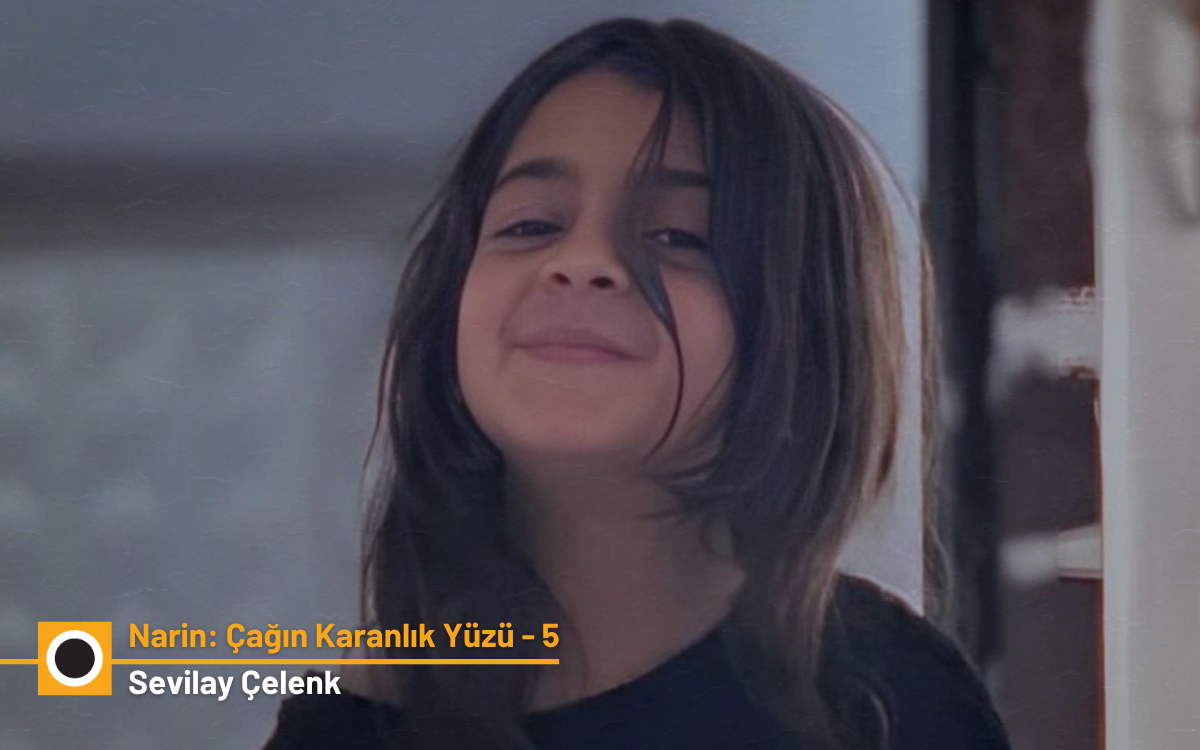
An Isolated Family: The Silence of the Gürans
The Güran family was left utterly abandoned and alone as a result of systematic public and media pressure. With infuriating insistence, they were forced to speak about an incident that took place in a secluded spot and that they had no way of seeing. As if such a thing were happening for the first time in the world. As if a case where a little girl was cornered and killed in a secluded place by a pedophilic sociopath — and beyond that, by a killer who bore a grudge against the family due to a dispute — had never before occurred on this planet.
Throughout the “Narin Case” hearings, Yüksel, Arif, Enes, Salim, and their lawyers talked and talked for hours. They told everything — in other words, the only thing they could tell. They explained what they did that day, what kind of family they were, what happened in the days that followed. They spoke desperately. That was all they could tell. Yet an entire country, which almost refused to deem the killer worthy of being called a killer, kept saying, “Why are you silent?” Everyone trampled on the family’s life, honor, and dignity, and continues to do so, because they “failed” to reveal the simple truth standing in plain sight.
Now, with her broken Turkish and fragile frame, how is Yüksel Güran supposed to explain that her beloved daughter never made it home that day, that she was cornered and taken from life just a hundred meters down from her own house, in a blind spot where no family member could possibly see her? What should she say to those asking, “Why are you silent”? To whom should she tell that the cameras which saw everything were left unexamined for days, effectively made blind, and that even the failure to review those cameras properly and in time was blamed on her own family?
The Chain of Negligence on the Day of Disappearance
Yes, the cameras at strategic points were never examined for 18 days, and they only stored footage for 15 days. The cameras that were supposedly examined were reviewed only from after 18:00, because they were said to show a time two hours later than when the child went missing! The claim by two people from the village that they had seen Narin in the evening, and the uncle’s natural act of relaying this information to the gendarmerie, formed the basis of the absurd accusation that the family had “misled the authorities.”
Astonishing Errors in the Law Enforcement Investigation
Imagine having camera footage right at your fingertips while searching for any trace of a child who left home at noon and never returned. How can it be explained that the officers responsible for reviewing those cameras decided to begin the examination only from the time villagers said they had seen her? What kind of irresponsibility is this?
If a child has gone missing, shouldn’t the cameras covering her path be reviewed at least from the early hours of the day — not only to find the child but also to see whether there was anything suspicious nearby? The accusations that made Uncle Salim Güran’s life unbearable are based entirely on his repeating to the gendarmerie what two children claimed — that they had seen Narin in the evening. The audio recording of Salim Güran’s conversation with the gendarmerie is here[1].
Salim Güran’s voice record
As can be heard, Salim Güran conveys exactly what he heard from others to the gendarmerie commander, just as he should have. The villagers, perhaps out of childish irresponsibility or simply by mistake, said they had seen Narin in the evening; this ruined the lives of both those children and the uncle who repeated it. The gendarmerie, or law enforcement in general, burned a family and set a village ablaze while shrugging off the burden of the investigations they had failed to carry out properly and in time. Knowing all this, how can we tolerate such injustice?
The Defense of Enes Güran and Forensic Realities
So what is Enes Güran supposed to do, what is he supposed to say? He was at home at the time; he had returned home after midnight from Malatya Arguvan, where he worked as an excavator operator; and everything he said was true — now confirmed in detail by a forensic IT expert through his phone’s image data. To whom should Enes Güran tell his story?
It was a miracle that Enes, who had started heavy labor at the age of 18 to support his family and was essentially still just a child, managed to maintain his composure at the trial despite the slanders and absurd accusations he faced. He, too, talked and talked and talked… He answered every question. Anyone can read his defense, yet what should Enes say to those who still, irresponsibly and cruelly, ask, “Why are they silent?”
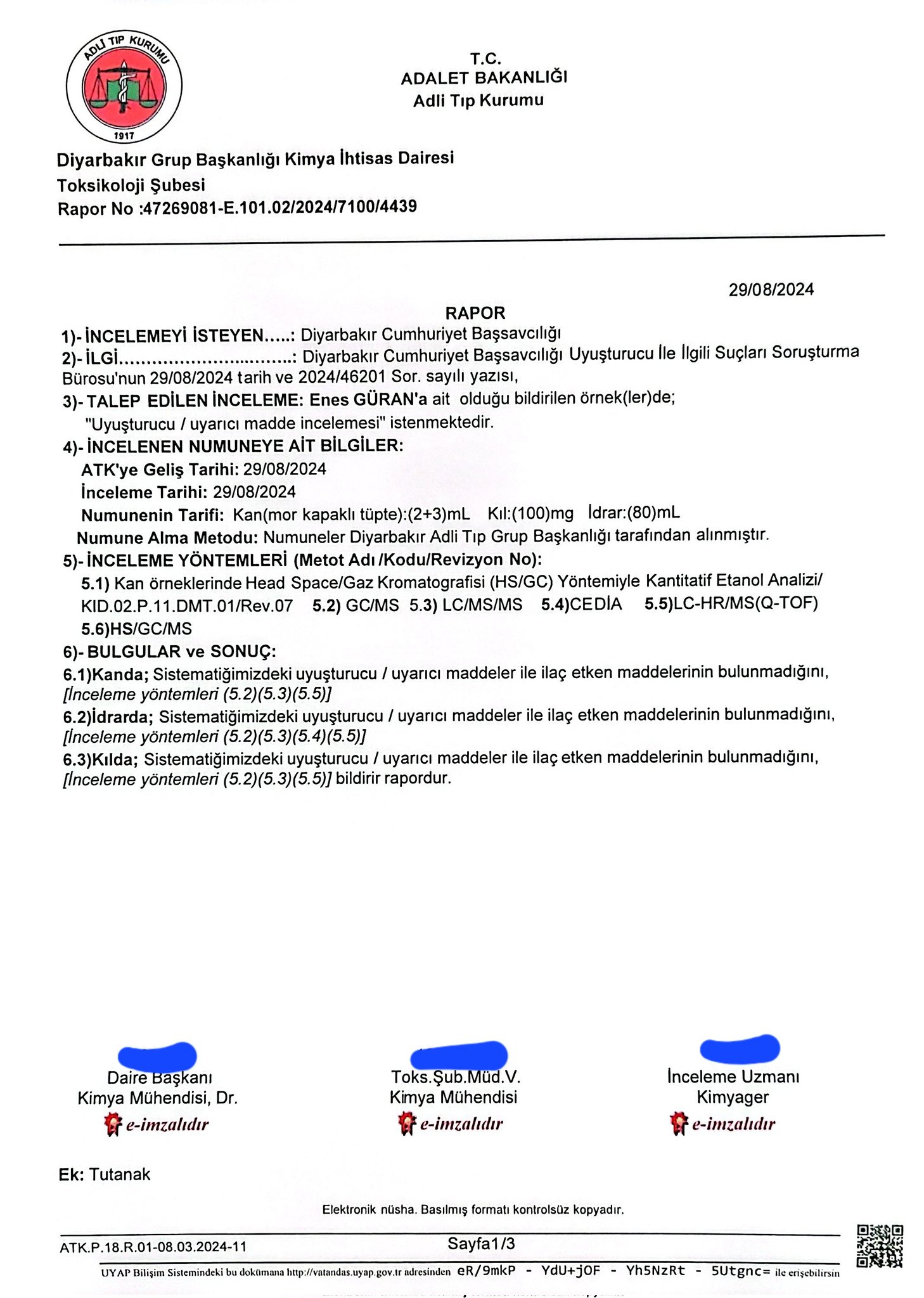
For example, the claims that Enes used drugs were refuted in the very first days with a doctor’s report. I’m also sharing that report here, but just like in political frame-up cases, no evidence, no document is accepted in the “Narin Frame-up Case” — because consciences are darkened.
Nevzat Bahtiyar and Ignored Suspicions
When the family was asked during the days Narin was missing whether they had any disputes with anyone, they pointed to Nevzat Bahtiyar. They said that a disagreement had arisen after discovering that Nevzat had sold them a stolen car, and that he had paid them 50,000 lira in compensation after the matter came to light[3]. Their statements on this issue were ignored, and they were met with the dismissive response, “Would anyone harm a child over 50,000 lira?” Yet there are countless similar cases. For instance, consider the first case in Turkey solved through DNA analysis[4] — how cruel, how similar, how thought-provoking it was. In Diyarbakır, a father and son were recently murdered and burned over 200,000 lira. Did no one hear about it?
In short, if the Güran family mentioned such a dispute, the person involved should have been immediately and seriously questioned. Since the case was brushed aside, the Gürans failed to suspect Nevzat, who had stayed close to them and appeared to be supportive during the search for Narin. They were so crushed by the grave accusations that their ability to reason about what might have happened was paralyzed. Among hundreds of gendarmerie officers, dozens of journalists, the constant comings and goings, endless gossip, and hostile stares, they came to distrust everyone and everything — even themselves.
Thus, they never had another chance to think or speak about the Devil again. Another accusation directed at the family was that when a red car was mentioned on the day of the incident, they did not immediately say it belonged to Nevzat. Yet the vehicle in which Nevzat is believed to have transported Narin’s body was apparently not his but his son’s, and the son did not live in the village. Therefore, whoever saw that car leaving the village did not recognize it. When a red car was mentioned, it was only natural that no one thought of Nevzat’s vehicle — one they barely knew, not well enough to recognize from afar.
The Unanswerable Question: “Why Were They Silent?”
People ask why they were silent, why they didn’t speak. But the real question should have been this: if Salim had killed Narin and given her body to Nevzat to make it disappear, and if the “killer family” knew everything, then to whom was Nevzat performing his theater of consolation for 19 days? Why did no one tell him to stay away, to stop roaming around?
Media Bias and the “Nevzat Wouldn’t Do It” Perception
The media and public opinion immediately removed him from the murder case by saying, “Nevzat would never dare to do such a thing.” Even the words of a neighbor or relative saying “Nevzat wouldn’t so much as say ‘boo’ to their chicken” were given importance in court and presented as proof of his innocence.
Yet most child killers already pay for their crimes with their lives. Many die suspiciously in prison soon after being incarcerated; some are killed before even being imprisoned; others spend years behind bars. None of this is ever deterrent. Lacking empathy, sociopathic child murderers clearly do not possess the mental capacity to weigh the consequences of their actions.
Nevzat, after placing three stones over Narin’s body and lingering inexplicably for some time, returned to the village, bought cheese from his sister-in-law, and drank tea… According to {internet traffic analysis[5], he did not access the internet at all from the time Narin disappeared on the school camera until after the minutes when her lifeless body was taken to and buried by the creek.
The Price of Seeking Justice and a Glimmer of Hope
In the end, the Güran family — and indeed the entire village of Tavşantepe — have been subjected to a trauma that will affect generations. To those who say to me, “Don’t you have anything better to do,” my answer is this: if I have played or will play any role in revealing the truth of this horrific event in my electoral district, in alleviating this trauma that will haunt generations, and in restoring the honor of innocent people, then that alone means I have fulfilled my duty as a representative. That is how I see it. We are faced with an event of immense significance. Besides, I am already busy — we are all busy — with many other things.
The Ethics of Standing with Those Unlike Us
The belief in the Güran family’s innocence is increasingly shared by more people. Much of the credit goes to their lawyers — Yılmaz Demiroğlu, Onur Akdağ, Mustafa Demir, Mahir Akbilek, and M. Fatih Demir — who have heroically fought for justice from the start under immense social pressure. While informing the public, they have also strived to maintain dignity and composure in the social media environment. They are aware of how deeply this relates to the pursuit of justice. They struggle tirelessly to avoid rashness and to protect the family from harm.
A Matter of Conscience Beyond Politics
As for me, while trying to support this quest for justice in my constituency, I still hear remarks like “This family expelled you from the village” or “Salim Güran said in court that he expelled DEM Party members.” Frankly, I cannot understand how this casts any shadow on the family’s possible innocence. They probably mean this: even if this family is innocent, why should you/we be the ones to defend their innocence — let them suffer their punishment. The “dark face of the era” I spoke of relates to this as well — the ease with which guilt is ascribed to those unlike us, and not just any guilt…
This unethical understanding of justice, which suggests imprisoning innocent people for life for crimes they didn’t commit, is truly repulsive. Let me clarify first: I went to the village during the days Narin was missing. No one there treated me or the delegation accompanying me rudely. We sat in Narin’s parents’ house for about 45 minutes, shared their anxiety, conveyed our good wishes, and left. But yes, I also heard Salim Güran’s statement firsthand at the second hearing.
Then and now, I think the same thing. Salim Güran, in despair, trusted the AKP government and the state, and believing that their perceived closeness to our party meant they could never escape this ordeal, he said, “I expelled the DEM Party from the village.” Otherwise, even if he did not sympathize with our party, there was no reason for him to say that in court. He would not have turned against any group — least of all a party that won eight parliamentary seats in Diyarbakır.
Anyone trapped so horrifically might have acted the same way, carrying in their memory the government’s intense campaign at that time to criminalize the DEM Party. In any case, regardless of the reason, it is truly shocking to think that the pursuit of justice — by one of the country’s largest political parties — could or should depend on whether sympathy toward it exists. We know well what a great legacy of struggle the DEM Party has inherited. Suppose a village from which it was “expelled” is unfairly set ablaze and not a single member turns back to look — then that legacy was never deserved, and nothing of it remains today. More importantly, in a matter that has captured national attention from Iğdır to İmralı, it is vital to imagine a pursuit of justice that rises above all such calculations and ideological divides. Such a pursuit exists, and it gives me great hope.