A Candle for Narin Güran II: A Blind Belief, an Invisible Suspect, Three Stories
An analysis of Nevzat Bahtiyar’s three changing statements as the last suspect in the Narin Güran investigation, the assumption that “she saw something she shouldn’t have seen,” and the scenarios constructed by law enforcement.
Nevzat Bahtiyar, the last suspect in the Narin Güran investigation, became the least-discussed name in the file. Although he made a partial confession, he was the most reticent of all the defendants. His inconsistent statements were interpreted by the court as the words of someone unable to express himself, and were thereby effectively trivialised.
In this part, my preference is not to postpone speaking about Nevzat Bahtiyar and his statements — and for me, this means stepping into the most demanding stage of the cold and complex case-file articles.
As we will recall, when Nevzat Bahtiyar was apprehended, he claimed that Salim Güran — who had been arrested on suspicion of murder eight days earlier — had handed Narin’s lifeless body over to him; yet he changed his account three times.
Probably, when one’s accomplice is arrested, one’s first concern is that they will speak and give one away. If one’s share in the crime is incomparably small, one is expected to be more inclined to confess. Especially if one was drawn into the crime under threat…
A Candle for Narin Güran I: The Wrongly Buttoned First Button
In Bahtiyar’s case, however, neither such concern nor any inclination to confess was visible after Salim Güran’s arrest. He preferred to remain silent until he was caught. In fact, four days before he was caught, he had been summoned to the Gendarmerie Command because he had called Salim Güran at 15:08; he initially did not remember the call and acknowledged it only when shown the records. He had also given false testimony, claiming that he had been outside the village throughout the day of the incident.
It also seems unlikely that, in such a situation, a culprit who is caught while their accomplice is in custody would tell a completely different story about how the events unfolded. They know that, after themselves, their accomplice’s statement will be sought. They may even think that they were caught on the basis of the already-detained person’s confession. Bahtiyar’s statements kept changing from the moment he was caught until his trial was concluded. We can examine, in broad outline, three different scenarios.
The First Scenario
He said that at 15:08 he had had a brief telephone conversation with Salim Güran about the water issue at his house, and that he then left his own home with his car. He said that when he turned onto the cemetery road, he noticed Salim Güran’s vehicle behind him. He recounted that Güran flashed his headlights and stopped him, then showed a lifeless body wrapped in a blanket on the front passenger seat of his vehicle and said, “You will get rid of this.”
According to Bahtiyar, Güran first threatened him by saying “Think of your family,” then offered a payment of 200,000 lira after the harvest. He then asked, “Do you have a sack?” and Bahtiyar took a sack out of his trunk. He claimed they put the lifeless body into the sack together and placed it in his own car. He said Güran gave a simple instruction such as “Throw it into the lake, get rid of it,” and then left.
After Bahtiyar’s arrest, his wife — whose statement was also taken — gave a similar account. According to her, Nevzat had called Salim Güran at 15:08. In the conversation, Salim Güran had said he was eating lunch at home and would call the authorities once he had finished. Nevzat Bahtiyar had then left home immediately after this conversation.
Bahtiyar’s first statement was almost identical to what was being said by accounts beneath Salim Güran’s last Facebook post — accounts that introduced themselves as employees of a petrol station — appearing after Salim Güran was taken into custody on 31 August. Because of this similarity, the statement was rapidly accepted in public opinion. Yet for that very reason, the security services should have approached its accuracy with suspicion.
Investigations revealed that the accounts in question were fake; there was no such petrol station, nor were there any of the employees claimed. Furthermore, Salim Güran going out of the village to such a petrol station and then returning did not fit within the time interval of the incident.
In the first hearing, Bahtiyar was asked whether he had seen these posts; he replied, “I didn’t see them, but I heard about them.”
Yet there was a common element between these posts and Bahtiyar’s statement, pointing to a piece of physical evidence: it matched the DNA data found in Salim Güran’s vehicle. What was striking was that the posts in question had been published on the very day the DNA was identified. Moreover, the posts gave the impression of being aware of the investigation’s scenarios. They referred to mother Yüksel Güran and elder brother Enes Güran, and touched on the call traffic that we often heard about in the media and that has now been understood to be groundless. Regarding the uncle Salim Güran, a scenario based on the 18:55 footage of him leaving the village had been constructed.
Carrying a corpse on the front passenger seat would not be ordinary either, but only those who knew Salim Güran’s car could have produced such a witness account in this manner; for the rear windows of the car were tinted!
The problem did not end there. For Salim Güran to have followed Bahtiyar in the way the latter described, he would first have had to drive past the school and therefore appear on the school camera. Yet there was no such recording on the school camera. There is no record in Bahtiyar’s interrogation transcripts of any question being put to him about this contradiction; even so, in his prosecutorial questioning, Bahtiyar appeared with a new scenario that resolved this contradiction.
A Candle for Narin Güran III: Prejudices, Media and Collective Evil
The Second Scenario
According to the second account, after Nevzat Bahtiyar made the call at 15:08 about the water failure, he had gone outside and started watering the garden with a hose he had drawn from his mother’s plumbing. About 15 minutes later, Salim Güran called out to Bahtiyar from the hill where father Arif Güran’s (Narin’s) house is located: “Nevzat, wait for me, we have business together.” Bahtiyar then began waiting for him in front of his house.
Salim Güran had come up to the front of Bahtiyar’s house with his own car, “not from the school side but from the mosque side” (the wording in the transcript is identical), and after saying “Get into your car and follow me,” had handed over the lifeless body to Bahtiyar on the stone road. Bahtiyar drove backwards to return to his residence, took a sack, and instead of taking the body to the burial site, placed it in the sack in front of his house.
In the Daran 2 camera recordings examined during the trial, no vehicle was found driving from the mosque road towards Bahtiyar’s residence.
Bahtiyar had also told the prosecutors, in response to a question, that two female family members might have had a relationship with Salim Güran, and that there were such rumours in the village.
The second hypothesis steering the investigation: She saw something she shouldn’t have seen / motive
Although there was no data at all pointing to such relationships, let us briefly probe the basis of this statement and similar rumours.
In the first article, I mentioned that the investigation took shape around a hypothesis about the time of the incident. The assumption developed about the motive of the murder — that Narin had “seen something she shouldn’t have seen” — was equally decisive in the investigation.
Narin, who left home to attend her religion class, had stopped by an uncle’s house to ask about her cousins, with whom she had planned to go to the class together. Learning that her cousins were not at home, she had headed directly to the class. In the footage caught by the school camera, she could be seen moving fast and looking back from time to time.
Law enforcement found Narin’s behaviour “suspicious” and, on this basis, developed the assumption that she had witnessed a deed that would not be looked upon favourably. We can also see this approach in the courtroom statement in which Arif Güran related his conversations with law enforcement during the early days of Narin’s disappearance:
“Narin was running from Uncle Hüseyin’s house. He pointed to the camera, ‘My daughter is running, that is, running…’ When she runs, she looks behind her three times. Why is this girl looking behind, well how would I know, commander? He said there is something here, there is something in this house, that’s why this girl came running from there.”
Furthermore, Ali Rıza Güran, one of the elders of the Güran family, recounted in his statements to the media that on the third day of the incident, a member of law enforcement had told them they thought Narin had witnessed an inappropriate deed in her own home.
Apparently, as can also be inferred from her mother’s statements, the hypothesis built on Narin’s footage on the school camera — footage of her behaving anxiously naturally because she was late for the class — that “she saw something she shouldn’t have seen” had made two houses suspect from the perspective of law enforcement.
Although it is not a common motive in child homicides, this assumption was never abandoned. As this thesis leaked into the media and aroused tabloid interest, combinations of relationships in which everyone was paired with everyone began to be produced; even possibilities of incest, homosexual relations, and even animal abuse were voiced. Speculation flared up further when the relevant footage was leaked onto social media.
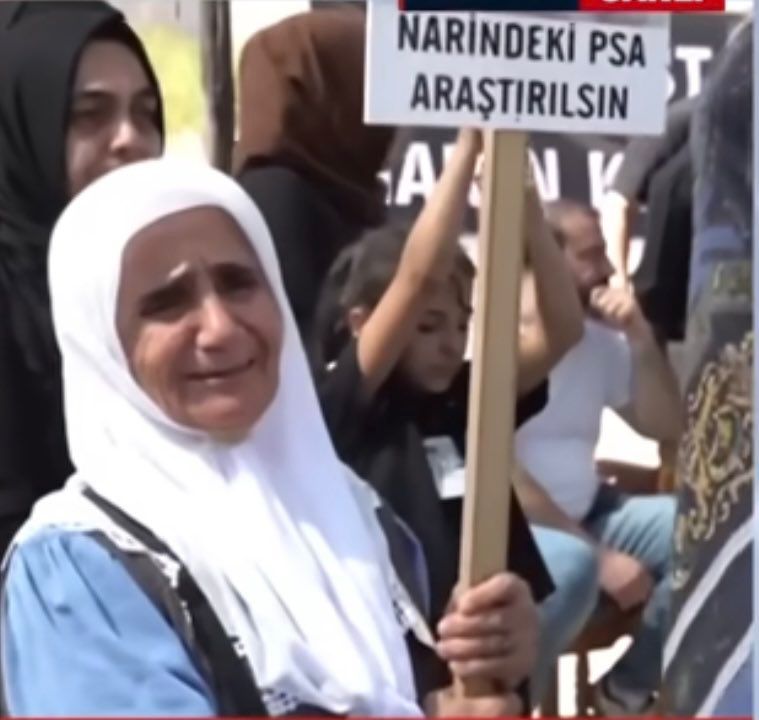
Even the PSA findings detected in the forensic medicine examination — in critical areas such as the vagina, underwear and the class clothes in the bag — were interpreted as “transferred from an inappropriate deed to which she was a witness.” Instead of probing the link of this finding to the motive of the murder, we see that the interpretive initial guess is still being insisted upon, and the question “What did Narin see that she shouldn’t have seen?” is still being asked.
Although an expert opinion was submitted to the file presenting a strong likelihood of abuse, this serious concrete data was overshadowed for the sake of an acceptance that had become a blind belief. Statements such as Nevzat Bahtiyar’s that he had given Narin money were not even taken into consideration.
The assumption that Narin had witnessed a deed that should remain hidden gained strength in an investigation in which nothing remained a secret — in an environment where the scenarios constructed by law enforcement inspired the media, social media and village gossip. Some family members heard this assumption directly from law enforcement from the very first days. Even sharing this information with someone they all trusted was enough for it to turn into village gossip…
Bahtiyar, too, had named the women living in two houses on which law enforcement had focused. We do not know whether Bahtiyar — whose statement was apparently shaped according to the questioning — was influenced by a question. However, given the course of the investigation, it would not be surprising if he had heard such gossip even before the news reports.
The Third Scenario
The local court based its ruling on Bahtiyar’s last statement, given two days before the indictment was submitted.
According to this account, Salim Güran — who, somehow, knew he would find Bahtiyar watering the garden — had called out from the hill, summoned Bahtiyar up, and they had entered Arif Güran’s house together. There Salim Güran had told him that he had killed Narin because she had witnessed his relationship with her mother. Yet for someone who killed his own niece because of such a witnessing to share this secret with an adult stranger was, in itself, a contradiction. The court would go on to interpret this contradiction as follows: Salim Güran was actually lying in order to hide a more serious motive!
In this statement Bahtiyar had also diversified his allegations of threats. Setting aside these details, they had wrapped the lifeless body in a blanket together and removed it from Arif Güran’s house. The slippers on the child’s feet — which Nevzat Bahtiyar had presented in his second statement as “evidence that she was killed outdoors” — had this time been picked up from in front of the house’s door. Furthermore, considering the reasoned ruling’s scenario in which the murder began in the barn and continued in the house, the slippers — which we would expect to have already been scattered — were at the door.
According to his account, Bahtiyar had descended a hundred-metre hill carrying the lifeless body wrapped in a blanket, came to his own barn, and there put the body into a sack. In his interrogation at the hearing, he said the sack was his own idea. He added that Salim Güran had said nothing about following him. Despite this, somehow sensing that Salim Güran was coming, Bahtiyar went to his car with a sack in one hand and the blanket in the other; while placing the sack on the rear floor mat of his car, he left the blanket outside. At this moment he had claimed that he saw Yüksel Güran weeping on the hill. However, according to Yüksel Güran’s lawyer, it was actually impossible for Bahtiyar to see her from the spot he described. Yet without the on-site reconstruction (keşif) procedure that the defence had requested being carried out, Bahtiyar’s statement was accepted as valid.
Just as Nevzat was ready, Salim Güran (again of course from the mosque side) had arrived in his car, gestured to the stream with his hand and said, “Take her away, dismember her if necessary,” and had taken the blanket and driven off.
In addition to his constantly changing, unconvincing statements that contradicted the evidence, there were other matters that raised question marks about Nevzat Bahtiyar.
Nevzat Bahtiyar’s relations with Salim Güran and Arif Güran
Although Bahtiyar and Salim Güran had had intense communication previously, this communication was seen to have been broken off for the past three months (other than three calls by Bahtiyar, once a month). At the hearings, Salim Güran explained the reason as a falling-out arising from a debt-and-credit issue resolved by the village elders’ mediation. This issue was between Arif Güran and Nevzat Bahtiyar. Salim Güran, for convenience, had offered Bahtiyar — who worked as a plasterer — work in exchange for the debt, but they had not been able to agree because Bahtiyar had wanted a high price. Although the issue had ultimately seemed closed, when one looks at the details, this disagreement that had not been resolved amicably had soured both Salim Güran’s and Arif Güran’s relations with Nevzat Bahtiyar.
That there was no relationship of domination and obedience between the Güran family and Nevzat Bahtiyar — as has been supposed — is clear even from this incident alone. Then why had Salim Güran chosen this neighbour with whom he was no longer on good terms, even at the cost of creating a witness against himself? Nobody knows. In any case, judging by Bahtiyar’s statements, creating a witness was not much of a problem for Salim Güran!
According to the prevailing public conviction, everybody already knows everything. Yet today, when we look at the process as a whole, we see that this conviction too was an assumption of the investigation itself. The abundance of witnesses ignored in favour of the family-member defendants makes it necessary to assume an organisation with many accomplices. In such a picture, was it possible that Bahtiyar — who lived right next to Arif Güran’s house — would not know what everyone knew, and that everyone knew it? He had been unable to give a convincing explanation of what had happened to Narin, had taken part in the search activities only for show, and had consoled the family members.
How did Nevzat Bahtiyar evade law enforcement?
If the camera recordings and Yüksel Güran’s statement had been taken into consideration, Bahtiyar — who could have stood out as a suspect from the very first day — could have been noticed; instead, the information of 256 people who lived in the village before him had been sought.
According to Arif Güran’s accounts, when the gendarmerie personnel asked him whether he had any debt-and-credit dispute with anyone, Arif Güran had given Bahtiyar’s name and that of one other person. However, this information had not been taken into consideration.
Through the statement taken on 4 September, Nevzat Bahtiyar must have learned that he had to give a statement that did not contradict the call records. In his statements he said that Salim Güran had honked and flashed his lights; that he had called out from a hill. Yet he never made the “mistake” of mentioning a phone call. He could have said that he had received the lifeless body from Salim Güran already inside a sack; this might perhaps have been more believable, but because of the well-known posts — even though the blanket was never found — he stuck with the blanket-based scenarios and left no opening on the matter of the sack either. In spite of all his inconsistencies, it was possible for him to give statements that, at the start, did not contradict the initial evidence.
Whether Bahtiyar gave his third statement of his own volition or upon the prosecutors’ summons is a contested matter. Although it was relayed differently to the public, at the hearing Bahtiyar said he had given this statement upon being summoned by the prosecutors. It was this third account that made the prosecution of mother Yüksel Güran and elder brother Enes Güran possible. With this statement, however, Bahtiyar seemed to have lost the trust of those — outside of judicial bodies — whom he might have been able to convince. At the hearing, Yüksel Güran put this point as follows: “If Nevzat had said that he had received Narin from Salim in the car, I would have said the two of them did it; a mother’s heart… but Nevzat is lying.”
Nevzat Bahtiyar after the incident
Nevzat Bahtiyar said that he spent about 38 minutes at the streambed where he had buried Narin, and that — when he could not find a suitable rope to tie up the sack — he remembered the strap of the child’s bag and used that to tie the sack. He then went to his sister-in-law’s house in another village, drank tea, bought cheese, and returned to his home in Tavşantepe.
By the time Bahtiyar returned, Salim Güran was already in the field. Apparently, Bahtiyar — who had planned and completed alone the cover-up to which Salim Güran, beyond a hand gesture and a sentence, had not contributed — was in no hurry to inform Salim Güran that he had taken care of the assigned task. It was Bahtiyar himself, again, who said that he did not contact Salim Güran by phone or face to face after the incident.
His sister-in-law and her three daughters stated that Bahtiyar was as he always was, that they had not noticed any anxious or unusual behaviour. After the murder, Bahtiyar appeared to have continued his daily life calmly and as usual; he had not even postponed an ordinary task such as buying cheese.
Nevzat Bahtiyar’s wife had said in the early stages of the investigation that it was she who had asked Nevzat to buy cheese that day. At the hearing, however, she made a different statement: “I had told my sister to make cheese two or three days ago. When I called, Nevzat was with me. It was around five or so… Nevzat brought us the cheese. When he brought it, he left the cheese, sat on the balcony for a few minutes. Then he left again. He said: ‘F.. comes back from work, I’ll pick him up at Çarıklı and bring him home.’”
If this statement is correct, Bahtiyar had bought cheese because of a call he had witnessed a few days earlier. In that case, there was no urgency at all in buying cheese. However, when he returned to the village, if he had encountered people who had noticed the child’s disappearance and his suspicious departure from the village, he was in a position to give an explanation: he had gone to buy cheese!
Nevzat Bahtiyar’s son — who was outside the city and had returned to the village two days after the day of the incident — was questioned six days after Bahtiyar’s arrest, and an excerpt from his statement about the day he returned to the village stood out: “I asked my mother, how did Narin go missing? She said, ‘I don’t know, we searched too, we couldn’t find her.’ I asked, was my father at home? She said, ‘He had gone to buy cheese…’”
Of course, this could also be a statement influenced by subsequent information. But this issue had not been probed: while even law enforcement had been unable to determine the time of the incident until Bahtiyar was caught, how did Bahtiyar’s wife know it just two days later?
Nevzat Bahtiyar, who was acquitted of intentional homicide of a child, was the only defendant whose physical contact with the lifeless body was certain and whose residence stood at the centre of the chain of events; yet no biological samples were searched for in his home. His family members were not effectively questioned. Moreover, even the HTS records revealing the phone traffic only entered the file at the request of the Güran family’s defence lawyers, before the verdict hearing.