An Open Letter to the Judges of the Narin Case
I am now a dead woman, a corpse, at the bottom of a well. It has been long since I took my last breath, my heart has long stopped, yet no one but my vile murderer knows what happened to me. He, that disgusting wretch, listened to my breath to make sure he had truly killed me, checked my pulse, then kicked me in the side, carried me to the well, lifted me and dropped me down. My skull, which he had previously smashed with a stone, shattered into pieces as it hit the well; my face, forehead, and cheeks were crushed and disappeared; my bones broke, my mouth filled with blood. — Orhan Pamuk, My Name Is Red
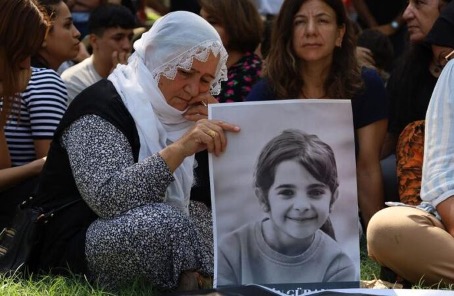
About 2000 years ago, at the very beginning of our calendar, they tortured Jesus Christ with spiked rods and barbed whips; they placed on the head of this good-hearted man, who spoke of the kingdom of heaven — or the son of God — a crown of thorns, and then threw him into a dungeon to bring him before Governor Pontius Pilate the next day. That night, Pontius Pilate’s wife, Claudia Procula — who, though not considered a saint by Catholics, is regarded as one by the Orthodox — pleaded with her governor husband: “Can you not pardon him?” Pontius Pilate said that, should a new uprising of the Israelites occur, Emperor Augustus would have his head; he was trapped between his office and justice. And finally the day came, they stood the Messiah beside Pontius Pilate; he was covered in blood, the vindictive crowd had gathered. “Here is the pitiful state of this insolent one,” said Pontius Pilate. “Is this not enough?”
It was not enough! The rabbis cried out in unison, shouting their true demand: Crucify him!…
Honorable Judges, Esteemed Justices, I wish to address you in whatever manner most flatters your pride; I do not wish to take risks, for this is my final article on the matter, the last bullet in my rifle. Whether you are truly venerable, whether you possess any respectable side, I do not know. Perhaps you arrived at your positions through various patronages. Perhaps you arrived through hard work, yet all you ever did was pass a few exams, keep your hands clean, become judges, and in this life, take pleasure in the tension your arrival and departure — “the judges have come, the judges have gone” — created among a few drivers and bailiffs. You strove for this and received your reward. The bailiff, the driver, the police officer, even the young clerk are anxious; rest assured, you have succeeded. But perhaps it is not so; perhaps you realized, even in childhood, how terrible and suffocating tyranny and injustice can be, and you labored since those years, and now you have become such sensitive and serious practitioners of law that you can sense the rise and fall of a prisoner’s anxiety in the swallow of the throat you button your shirt over every morning in front of the mirror. The weight of the duty to deliver justice presses upon your chest like a gravestone, and you speak only after thinking a thousand times with utmost seriousness. You live with the noble relief of passing through the finest scales the judgments you issue about defendants whose ties to life and relationships hang by a thread. How beautiful it would be if you were such people; in a country with such judges, people would sleep peacefully at night. I did not try to learn who you are; had I tried, I would likely have had no strength left to write this letter — perhaps it would have scourged me further. You see, prejudice is a terrible thing, is it not, Honorable Judges? At the start of the paragraph, your eyebrows furrowed at my belittling assumptions, then, when I mentioned your noble purpose, a sacred illumination crossed your face, your hearts sweetened. Yes, these pre-judgments are terrible things; according to the man known as the smartest on earth, they are more difficult than atomic physics.
Still, let us incline toward the best possibility and assume you are the kind of human beings who deserve these noble stories, these invaluable quotations from precious novels, and let us come to our main matter.
They placed before you a family whose bodies may not be covered in blood, but whose world has been shattered; this family is called the Güran Family. They have a ringleader, a cruel village headman: Salim. He is not a Jesus Christ, yet — just as Jesus advised his apostles eager to stone a prostitute — he is as guilty as the one among us who must cast the first stone, meaning he is as guilty as all of us, as innocent as all of us. The greatest crime of this headman, who has been stoned by nearly the entire pure and spotless total of 85 million people, is said to be the messages he deleted to cover up the sex workers he slept with and a few illegal electricity dealings — and, of course, the “DNA taken from a strand of hair fallen from Narin,” allegedly found on the right rear seat when the entire Narin family got into the headman’s car on their way to a wedding. Whether or not you are familiar with what we previously wrote, let us repeat the most crucial point: how this whole affair became a tangled mess and how it ultimately turned into a 14-page document called an indictment. Let us examine once more what happened. As we have written repeatedly, everything began with a fabricated, baseless gas station lie about Salim Güran in a Facebook post. In that post were Narin’s mother, the blanket, the front seat, the car, and of course Salim. This entire storm of lies was built upon that, Honorable Judges; the source of the lie “Narin saw something and was killed” is that Facebook post, which drove an entire country into this mental blackout through the media. In fact, in Nevzat’s first statement — the very same Nevzat whom the media wrapped delicately in cotton as the real likely murderer — you can see these exact core details from that post. In his panic, the first thing Nevzat clung to was this Facebook lie. When the crime scene investigation images surfaced recently, our clever public exclaimed, “This man is too stupid; he couldn’t have killed this girl!” As if killing and burying an eight-year-old girl is something an intelligent person would do — I truly cannot grasp the logic. In any case, while everything was this clear, the Prosecutor did not do what a legal professional should have done and instead tossed the matter to you.
This indictment clearly relies on Nevzat’s latest statement, yet it does not even dare to admit this. The reason for all this timidity is obvious, for the Prosecutor seems to have chosen, as a cunning escape route, not to base everything on the words of a liar full of blatant contradictions. Naturally, the Court will ask the Prosecutor: “You accepted everything Nevzat said, yet why did you not write ‘murderer’ when he said ‘murderer’?” Honorable Court Panel, I hope you show a bit of reproach to this Prosecutor who tries to shift responsibility onto you to escape the media’s wrath. I am very curious about what answer he will give: Will he say, “We cannot trust all of his statements, but I had no choice except to present some of Nevzat’s accusations to you as an indictment in order to save myself”? Or will he say, “Be clever like me, hand down the sentence and send it to the Court of Cassation, enough of this dragging on”?
According to the Prosecutor’s indictment, Salim Güran informed the gendarmerie that the Roma had mentioned a red car — supposedly to secretly expose Nevzat. He supposedly committed such foolishness without caring that he might be implicating himself! His going back and forth to the stream right beside the village was also considered suspicious. If they searched for the girl, it was a crime; if they did not search, it was also a crime — what else were these “diabolical yokels” supposed to do? Did you, by chance, have any suggestions for them during the search? Forgive me, I forgot: on the third day, villagers were actually prohibited from participating in the search. Yet according to the shabby media, of course they were not eager to search for the child they allegedly killed! In a village surrounded by a stream and an irrigation channel, could there be any place more plausible to look for a missing child? What crime did the Prosecutor perceive in the occasional visits of the village headman and the head of the family to these places? I leave that judgment to you.
It is also sufficient to look merely at the statements of the mother and Enes to see how hollow the idea of an organized murder is; neither of them is speaking in Salim’s favor — they have said whatever they know. Enes and Nevzat describe Salim as almost their commander, indeed nearly their servant-master; so what exactly are they trying to protect of Salim’s, Honorable Judges?
Moreover, in this indictment based solely on Nevzat’s statement, is there any reasonable explanation for the sentence sought for Enes? Is the Prosecutor truly claiming that eight-year-old Narin was more sensitive about honor than a 20-year-old male youth?
They say human memory is afflicted with forgetfulness. Shall we take a look, Honorable Judges, at the chain of lies that has collapsed one by one over the past three months:
- The gas station allegation — debunked.
- The claim that the sandal belonged to Narin and the mother was misleading — debunked.
- The allegation that the carpets were washed — debunked.
- The allegation that they used button phones as a precaution — debunked.
- The allegation that the imam was involved — debunked.
- The allegation regarding the “Is the girl dead or alive?” voice recording — debunked.
- The a burner SIM card allegation — debunked.
- The allegation that the accomplices misleading the gendarmerie were six years old — debunked.
- The allegation that the family member working at the State Hydraulic Works continuously increased the water flow so the body would decompose faster — debunked.
- The allegation that there were cameras in the houses and they hid this — debunked.
- The allegation that Narin was Salim’s biological daughter — debunked.
- The allegation that Narin’s DNA was on the front seat and the steering wheel — debunked.
- The allegation that the village was a Hezbollah village — debunked.
- The allegation that ammunition was found in the village — debunked.
- The allegation that Salim misled the gendarmerie and never mentioned the red car — debunked.
Let us close the topic of this boundless chain of lies with a personal anecdote: one day, a friend well aware of my preoccupation with this matter sent me a message: “See? You kept desperately defending the family, and now CNN TÜRK is breaking news: ‘According to the forensic report, the death fluid from Narin’s throat got onto Salim Güran’s hand, and from there onto the steering wheel…’” Yes, Honorable Judges, they said exactly this — they invented a new term for forensic literature, and to provoke the foolish masses, they called it “death fluid”… Death fluid…
I am inviting you not to conscience or mercy, but to your true duty — the task to which you owe your livelihood and your entire being — that is, reasoning, in other words, intellect and discernment, more concretely, the law. And I want to ask you this question: if the body of this delicate child had been found not after 19 days but after 2 days, and if the media’s ratings-driven and social media clowns’ engagement-hungry fantastical scenarios about the village had not existed, and if Nevzat had given this statement — would you have believed him?
A thief confesses to burying a bag full of stolen jewelry and tells you, “I didn’t steal what’s inside; someone else stole them and asked me to hide the bag,” and would you act as though you believed this merely to avoid the wrath of media buffoons?
On November 7, you will surely witness a commotion, an unprecedented uproar in front of the courthouse — countless vehicles with antennas, around 50 bar associations that have joined the invitation to lynch the family under the pretext of representing rights, law, and justice, perhaps numerous messages from ministers on your phones, various kinds of clownery — an unparalleled chaos. Do not say, “Well, all these people, all this media — they can’t all be fools; of course we must listen to the voice of our noble nation.” Yes, so many people can be mistaken — they always have been, and they will continue to be. I hope I am not pressing on your nationalist nerve, but I quote Ali Nesin: “Ninety percent of Turkey believes that sixty percent of Turkey is stupid.” As I said, there is no need to take offense; Turkey’s ignorance and foolishness, though delayed, have also appeared in now-just societies a century ago. The best-known example for you is the Dreyfus Affair. They taught you this at the very beginning of your education — I am writing this letter with that assumption in mind. If, in the future, when this cautionary event is taught in communication and law faculties, you do not want your names to be included, then I kindly ask you to continue reading this letter in good faith.
I implore you, Honorable Judges, free yourselves from the captivity of manipulative questions; there is no murder network masterfully covered up, no organized evil expertly concealed.
On a scorching afternoon, in a central village of Diyarbakır, a Savage took a little girl who was joyfully skipping past the front of his house; in that stillest moment when the cicadas lull a person into drowsiness, he strangled her, buried her in that cursed stream, and placed stones over her — that is all that happened. Saying “I don’t know” is not the same as cunningly hiding what you know, Honorable Judges; sometimes we truly do not see, do not hear, do not know.
The law cannot function based on “What will people say,” Honorable Judges; you do not wear that robe to keep your back warm!
Unfortunately, in Turkey today, there also exists a monstrosity of social media that has slipped into the hierarchy of the judiciary, and you have recently witnessed this uncontrolled madness; this unhinged, hysterical herd has even had graves opened — that is how powerful they are. Now, so that our esteemed ministers are not subjected for a few days to the lynching of this deranged clan of monkeys, you may be pressured into issuing decisions you do not believe in and do not wish to render. Your situation reminds me not only of Pontius Pilate but also of the character Kaymakam Halil Hilmi Bey in Reşat Nuri’s work, who was subjected to the bullying of the cruel Unionists; in enduring every kind of humiliation, Halil Hilmi Bey would take refuge in the couplet:
If I were on my own, I would never bow to the cruelty of fate;
but in this ruined household, I have a family I must provide for.
Of course, the children and family members waiting at home cannot be dismissed lightly; however, conscience and justice cannot be confined within this narrow couplet either, Honorable Judges. Yours are children and family members, but so are everyone else’s. And rest assured, fulfilling the requirements of the law will not bring disastrous consequences upon you; if there is a city more Kurdish and further east, it would be Kermanshah in Iran — they are certainly not going to send you there. If you say, “You cannot deceive us with such things; we do what is easiest for us,” be assured that after doing so, you will be honored with a few days of exaggerated praise from the base and contemptible elements of social and conventional media. “Behold, the great Turkish justice has manifested, long live our judges!” they will say. But do not be overly proud; when the same people later see a survey concerning trust in the judiciary, they will not hesitate to mark you as 90% untrustworthy. This rotten case, built upon the rumor that “Narin saw something and was killed,” will thus be closed from your perspective — you will not have brought trouble upon yourselves. Everything will be that easy, done and over.
But there is also the difficult path — allow me to describe it. In the passage we quoted above, where Turkey’s greatest living writer Orhan Pamuk refers to the vile murderer, there is one more sentence spoken by the victim: “I see now that my life was nothing but a light stretched between two darknesses extending into eternity…” Yes, Honorable Judges, that is what we call life. If you are believers, perhaps for you that light continues; in any case, doing something unjust within this eternity — setting aside whether it is moral or conscientious — is, in my view, not even a wise act for the sake of our earthly comfort. If you say, “We have rendered many decisions, this means nothing to us,” I am not convinced. I do not believe you have ever faced a case as sharp as deciding between aggravated life imprisonment or acquittal for a mother whose child was murdered in a barbaric way; this is not a dilemma to be taken lightly. And do not deceive yourselves by saying, “We will issue this decision, Yargıtay will fix it anyway.” Years pass, hearts stop in prison cells, brains bleed, organs turn cancerous — countless calamities await the convicted… This is not a burden one can shoulder. I am not even counting the viran lives of those outside.
And if you still insist on doing as you please, and wish to please the base, ignoble vulgarity of social media and the media, know this: those charlatans will find another spectacle to trample on three days later, but the shadow of the moral burden this matter brings upon you will continue to envelop your life. This injustice will appear to you like a misplaced ghost — sometimes as a repulsive fly landing on the cheese at a Sunday breakfast table, sometimes bursting forth like a whale from the water at the moment you are on the verge of finding peace while gazing at the sea. For years, whenever it comes to mind, you will lament, saying, “If only we had fulfilled the requirements of the law on that day,” and you will grieve. If anything resembling peace and happiness exists on this earth, know that nothing is a more insurmountable, lasting, or unyielding obstacle than pangs of conscience. Ten years pass, twenty years pass — everyone forgets, but you will remember; you will begin your sorrowful tale with, “Once, in a village of Diyarbakır, on an August afternoon, a little girl was killed…”
Back to top