The 12 media mistakes that influenced the judiciary in the Narin murder case
The murder of Narin Güran became the subject of one of the most mediatized cases of recent years. The trial began and ended, and three members of the family were sentenced to life imprisonment. Yet neither the media’s all-knowing experts, nor the esteemed commentators on TV screens, nor the gendarmerie, the police, and ultimately the judiciary were able to fully clarify this murder.
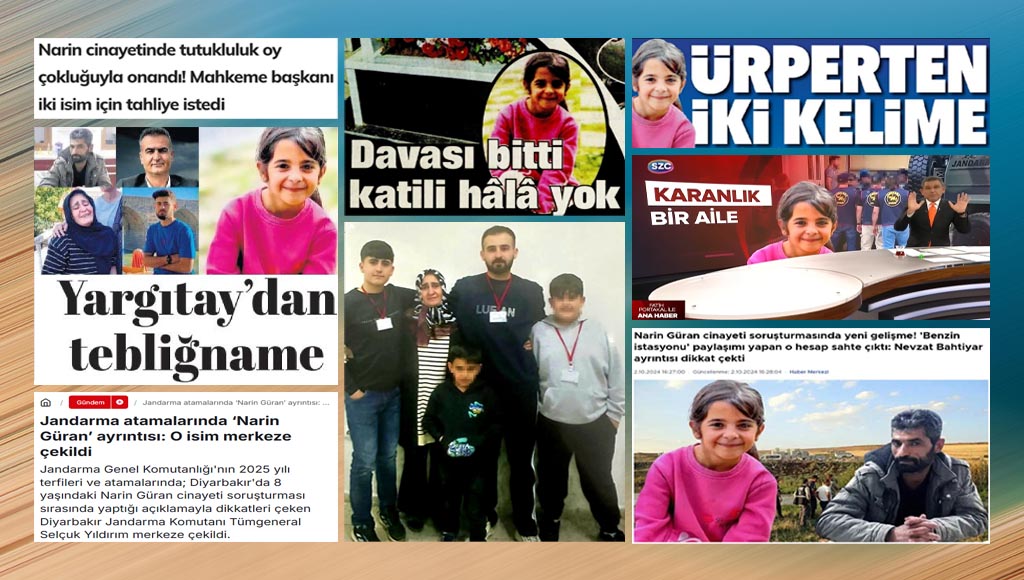
This is not an allegation. Even in the Diyarbakır 8th High Criminal Court’s reasoned judgment, a coherent narrative explaining how the murder was committed cannot be established; it is explicitly acknowledged that the motive for the murder could not be determined. Moreover, the court could not answer the question of why Salim Güran, instead of taking the body himself and hiding it in the stream, handed it over to Nevzat Bahtiyar—thereby sharing a very important secret that still remains unknown.
Indeed, the President of the 1st Criminal Chamber of the Regional Court of Appeal, who dissented from the Chamber’s decision to uphold the verdict, particularly emphasized that the motive and manner of the murder could not be determined. The President listed the legal deficiencies in the investigation and prosecution in 14 points.
The point that struck me most in the President’s detailed dissenting opinion was his emphasis that “according to the new situation that emerged after news and discussion content in social media and TV bulletins, there were changes in the defendants’ statements.” The President had clearly observed the media’s influence on the trial through the statements.
“The statements of defendant Nevzat, which our court deemed credible…”
Having written the President’s dissent—which received almost no attention in the media—under the title “What if the Güran family really is innocent,” I tried to draw the media’s attention to the legal shortcomings highlighted by the President.
Naturally, after reading the President’s findings, the question also formed in my mind: “To what extent was the media influential in this investigation and trial?” To answer this question, I examined the court’s reasoned judgment carefully.
Although the court referred to reports, HTS records, and narrowed base station data as evidence, the actual basis of the decision was the statements of Nevzat Bahtiyar. Furthermore, the court did not accept as truthful the statements of anyone from the Güran family—especially Salim, Yüksel, and Enes—and instead relied on the account of Nevzat Bahtiyar. Indeed, the reasoned judgment stated, “The statements of defendant Nevzat, which our court deemed credible…” In this way, Nevzat Bahtiyar escaped with a prison sentence of only four and a half years.
Can you imagine? The court based its decision largely on the statement of a single defendant, yet even that defendant’s statement had changed due to media reports and discussions! That defendant changed his statement at least three times and described the course of events differently each time!
Given this, to reveal the media’s influence in this process and identify journalistic mistakes, I thought I needed to go back to those days and review the news, commentary, and even TV programs from that period.
First, I compiled the media reports and commentary from 21 August 2024—the day Narin disappeared—up to the early days of the trial. In doing so, I not only prepared a roadmap for myself but also created a flow chart so that readers of my analysis could see the atmosphere that formed in the media at the time. (*)
The turning point
The media story of this murder and trial began with reports that one of Narin’s red slippers was found three kilometers away the day after her disappearance.
Immediately afterward, reports emerged that the slipper did not belong to Narin. Waves of false tips followed, and then came reports of bite marks on older brother Enes’s arm and scratches on his back, of the gendarmerie cross-examining family members, and of the uncle being detained after Narin’s DNA was found in his vehicle.
I think the turning point was here; Narin’s body had still not been found, and the date was 1 September 2024. From that day forward, suspicion in the media focused on the Güran family.
Then, during Narin’s funeral, a woman from the village shouting to the crowd, “Go and lie, okay,” and AKP Diyarbakır MP Galip Ensarioğlu saying on Sözcü TV, “There are things we sometimes don’t know and sometimes know but must not say. Because the family is also our friends,” were major developments that caused the media to concentrate entirely on the family.
Interestingly, at this stage, the statements of the suspects and almost every development in the investigation were reflected in the media within hours. It appears that even the prosecution, which requested a confidentiality order, was not particularly disturbed by this.
The media accused the family first
After Narin was buried, reports and commentary appeared one after another, claiming that her brother had also been murdered, that Tavşantepe was—depending on the source—either a “village of guards” or a Hizbullah village, that immoral relationships were taking place in the village, that Narin had been killed because she witnessed a relationship she was not supposed to see, that the entire Güran family was involved, and that they misled the gendarmerie during the search.
While the family was being declared guilty, the fact that the red slipper—later determined not to belong to Narin—had been placed near the tents of Syrian refugees, along with contradictory statements about it, was being discussed. There were also allegations that the gendarmerie had been misled through false tips and that a fire had been set in the village on the evening of 24 August.
In fact, even before the court believed him, it was the media that had believed Nevzat Bahtiyar and treated his account as the truth. On this matter, a near-consensus had formed between pro-government and opposition media alike.
On 10 September, in the first reports about Nevzat Bahtiyar after his arrest, headlines almost always used the words “Confession” and “Confessor.” This framing dominated reports on Akşam, Habertürk, Haber Global, Hürriyet, Medyascope, Sabah, and Sözcü TV.
Yet it was unclear how truthful Nevzat Bahtiyar was, and his statements contradicted one another. Nonetheless, the media did not dwell on the possibility that he might have committed the murder himself; this possibility was not even mentioned.
Particularly on TV, commentators, experts, and columnists began to assert conclusions such as, “Actually, the whole village knows about the murder and is hiding it,” and “A collective murder.” These opinions were presented as if the truth had been uncovered and proven.
For example, Nazlı Çelik, anchor for Star TV’s main news broadcast, declared, “Everyone kept silent; everyone turned a blind eye, covered up the murder, pretended not to have heard, seen, or known. A whole village of family members forgot their humanity,”[1] while Fatih Portakal labeled the entire family as “a dark family” on Sözcü TV[2].
Hürriyet also put on its front page, without concrete data, “The triangle of evil: The whole family is involved.” In another story, it interpreted the installation of cameras in certain homes before Narin’s body was found as a sign that they “knew in advance” that Narin had been murdered.
On NOW TV and A Haber, commentators claimed that “They knew Narin had been murdered and did this to prevent the body from being left near their homes.” On Halk TV, it was said that “Many people had prior knowledge of this matter. It emerged in police examinations that 80 percent of those detained in the village had changed and wiped their phones, deleting their WhatsApp conversations.”
Yet the claim that nearly everyone in the village had changed their phones and deleted their communication records was not true. Indeed, during one hearing, Diyarbakır Bar Association President Nahit Eren said, “The entire Güran family—well, not the entire family, let me not say that, 6–7 people, I won’t name them—deleted all their call records.” In the additional “harboring a criminal” case, only uncle Fuat Güran was found to have deleted his phone records.
The media had taken sides
What should not have happened during such an investigation and trial did happen: much of the media took sides. Many journalists stationed in Tavşantepe Village began to see themselves as police or prosecutors. In news reports, commentary, and TV debates, broadcasts were mostly made with the presumption that uncle Salim, mother Yüksel, and older brother Enes Güran had committed the murder.
As a result, days before the murder trial even began, the media had already constructed the myth that the entire village had prior knowledge of the murder and concealed it. Once such a myth had been created, the court’s verdict surprised no one. The decision was accepted as it was and not sufficiently debated in the media.
Although some stories appeared, such as Sabah’s “The trial is over, but the killer is still unknown,”[3] the media glossed over the case with small updates about the appellate affirmation, the Supreme Court appeal, and the rejection of the release request, leaving it to age in the archives.
Recently, two new developments occurred regarding the case: first, Diyarbakır Gendarmerie Commander Major General Selçuk Yıldırım was reassigned to headquarters. It was claimed that his statements during the investigation caused discomfort[4] in Ankara and at the Gendarmerie General Command. Second, the Office of the Chief Public Prosecutor of the Court of Cassation prepared an opinion[5] recommending the upholding of the sentences. The file is now before the 1st Criminal Chamber of the Court of Cassation for appellate review.
I have also completed my examination, which took some time, listing the reports and commentary that influenced the investigation and trial process in the Narin Güran murder case but were later found to be definitively incorrect. Had I continued, the number might have increased, but I decided to stop at 12; the article would have become even longer and required more time.
These 12 mistakes are enough to show what kind of journalistic trajectory was followed in the Narin Güran case file. Here are the 12 headings I identified through my media review and examination of the court’s reasoned decision and the appellate decision—mistakes that influenced public opinion and the court but were later proven false:
Mistake 1- The gas station employee: “Narin was lying unconscious in her uncle’s vehicle!”
When uncle Salim Güran was detained on 31 August and arrested on 2 September, Narin’s body had not yet been found and Nevzat Bahtiyar had not yet been caught.
Immediately after the detention was reported, Akşam published a story titled “Strangulation evidence in the car: Death fluid on the seat and steering wheel.” The discovery of Narin’s DNA on the driver’s seat cushion sparked excitement on TV debate programs, used as proof that uncle Salim might be guilty.
The media followed this lead. On 4 September, reports appeared titled “Turkey has been searching for Narin for 15 days: Horrifying allegation from gas station employee! Was she lying unconscious in her uncle’s vehicle?” These reports, published on A Haber, Gerçek Gündem, Halk TV, Takvim, CNN Türk, Karar, T24, and Türkiye, were based on “a social media post by a gas station employee named Murat Çınar Çatalca.”
This person claimed that Salim Güran had bought only wet wipes from the station that day and that Narin was lying “unconscious or strangled by hand” on the front seat wrapped in a blanket, and that the footage had been given to the gendarmerie.
The truth: There was no such gas station employee; the account was fake
After Nevzat Bahtiyar was caught, in his first statement to the prosecutor on 9 September, he said that Salim Güran had shown him something wrapped in a blanket inside the car and told him, “You will dispose of this,” and that he had seen Narin’s body in Salim’s vehicle and taken it from there. He even repeated this during the camera-recorded “scene reconstruction.” These statements were consistent with the “gas station employee’s” social media post! Even though in his second statement on 10 September he recounted different details, he still claimed he took the body from the car.
But in his 21 September statement to the prosecutor, Nevzat Bahtiyar completely changed his account of taking Narin’s body from Salim’s vehicle:
“Salim Güran called me. We went together to Arif’s house. I saw Narin Güran lying motionless on the ground. After placing her in a blanket, Salim Güran handed the body to me. I took the body into my arms, left the house, and carried it to my residence to put it in my vehicle.”
His claim that he took the body from the family’s home overturned his earlier narrative and erased most of his first two statements.
It is unknown whether this change in statement was related, but shortly afterward it emerged that the Facebook account of the so-called “gas station employee” was fake, that no such employee existed, and that the information shared was false. On 2 October, reports[6] confirming this were published.
The court accepted as true Nevzat Bahtiyar’s final statement—repeated during the hearings—that he took the body from the house, first carried it to his barn, put it in a sack, and transported it by his own vehicle to Eğertutmaz Stream. Thus the court concluded that Narin was not killed in uncle Salim’s vehicle and her body was not transported with that vehicle.
Nevertheless, relying on Nevzat Bahtiyar’s assertion that “there was a frothy liquid in Narin’s mouth,” the court reasoned that this liquid might have gotten on Salim Güran’s hand and that he might have wiped his hand on the seat. Salim denied this “absolutely” and said, “It would be normal for Narin’s DNA to be found in my vehicle; I would be surprised if it wasn’t. It is the family car.”
Yet the court’s reasoned judgment stated, “It is clear that after Narin was killed, either Narin herself or an object that came into contact with her body was transported with Salim’s vehicle.” The court thus based its decision not on evidence but on assumption. The President of the Chamber, who dissented from the appellate decision, also emphasized that the investigation on this point was incomplete.
Although the blanket was never found and the “gas station employee” turned out to be fake, the reports published before Narin’s body was found—“Horrifying allegation from gas station employee! Was she lying unconscious in her uncle’s vehicle?”—contributed significantly to the perception that uncle Salim Güran and the family were guilty.
Mistake 2- Narin was killed because she witnessed the forbidden relationship between her uncle and her mother!
About a week after Narin disappeared on 21 August, with older brother Enes, uncle Salim Güran, and then all family members taken into custody, various scenarios began appearing in the media. Most frequently, it was claimed that Narin had been killed because she witnessed something she was not supposed to see.
In Nevzat Bahtiyar’s first statement to the gendarmerie on 9 September after his capture, there was no allegation of a relationship between uncle Salim Güran and mother Yüksel Güran. In his 10 September interrogation, he added “sexual relations” to his initial statement, saying, “I did not ask why or how he killed Narin, and I do not know. But it was being talked about in the neighborhood that Salim Güran[7] had relationships with Yüksel Güran[8] and M.G., who is the wife of his own uncle.”
The reason for such a change in Nevzat’s statement within a day is unknown, of course. But on 9 September, on her Show TV program, Didem Arslan Yılmaz said, “I’m saying 99 percent. According to my source, there is a relationship between the mother and the uncle. According to the allegation, the reason for the murder is that the child witnessed the relationship between her mother and her uncle…”[9] and rumors in this direction spread rapidly.
Immediately afterward, the media began publishing intense “forbidden relationship” reports. On 11 September, Hürriyet’s headline “Four scenarios in the Narin murder” included “Did she witness the forbidden relationship?” as one of the scenarios. Hande Fırat also wrote, “According to senior officials, Narin might have been killed because she witnessed a scene at their home.”
On 17 September, Hürriyet again carried “Plan in the house, murder in the barn: Narin witnessed a three-way twisted relationship involving her uncle, her mother, and an aunt,” while Show TV escalated the claims with reports like “Twisted relationships in the dark village, horrifying secrets revealed.”
On Sözcü TV, the headline appeared: “Incredible events in Narin’s death! Her uncle may be her father!” pushing the allegation even further.
About ten days later, in his third statement, Nevzat Bahtiyar alleged that Salim had told him, “I killed Narin because she saw us together with Yüksel.” Subsequently, headlines like Sabah’s “Forbidden relationship confession: The murderer who buried Narin in the stream also confessed the forbidden relationships” spread widely.
The truth: There was no sexual relationship between the uncle and the mother
Nevzat Bahtiyar repeated in court his allegation that Narin was killed because she witnessed a relationship between Salim and Yüksel. But the allegation must not have been very convincing, because the presiding judge reminded him that the time when Narin was last seen on the path leading home was close to the time Nevzat arrived at the home and asked, “When did Salim have time to have relations with Yüksel for Narin to have seen it?” Nevzat answered, “I don’t know. I did not see it.” Salim and Yüksel Güran both vehemently rejected the allegation as “slander.”
Indeed, the court’s reasoned judgment stated that “it has been concluded that defendant Yüksel did not have a relationship with defendant Salim at the time of the incident.” However, the court still accepted Nevzat’s account as true and rejected Salim Güran’s defense as false. This acceptance was based on the court’s conclusion that “defendant Salim made this statement to defendant Nevzat to conceal the real motive for killing Narin together—a motive that our court has also been unable to determine.”
Thus the court concluded that Salim Güran committed the murder to conceal a motive “more important” than a “sexual relationship” with his sister-in-law Yüksel but, somehow, entrusted the task of hiding the murder to Nevzat Bahtiyar. Yet the court could not identify this very important “real motive.”
The President of the 1st Criminal Chamber of the Diyarbakır Regional Court of Appeal, who dissented from the appellate decision, found the court’s decision “contrary to reason, logic, the ordinary flow of life, and the patriarchal structure of the region.” He stated: “More important than whether the relationship between Yüksel and Salim was seen or known is the question of what the real motive for killing Narin was. No conclusion has been expressed within the scope of the evidence, and the conclusion and reasoning reached in the form of mind-reading based on abstract assumptions is unlawful.”
Mistake 3- Narin’s older sister was also killed by being pushed down the stairs!
After it became clear that Narin was killed and the family members were detained, social media and mainstream media began circulating claims such as “Was Narin’s sibling also murdered?” and “Her sister’s file has been reopened: The suspicious death of Tülin Güran is being investigated.”
Reports published in newspapers such as Sözcü, Yeni Akit, and Yeniçağ labeled her death as “suspicious,” claiming that “It was said that Tülin Güran died from falling down the stairs,” and that this allegation was also being investigated.
Some reports also claimed that Tülin Güran “died of pneumonia.” Her date of death was given as 2009 in some news reports and 2019 in others.
On 9 September, Fatih Portakal, while presenting his news program on Sözcü TV[2], said: “A dark family. Everyone knows who killed this girl. The death of her sister is also full of question marks.” The report that followed included the following allegations:
One of Narin’s cousins took his own life years ago; another attempted suicide and was left paralyzed. It also emerged that her disabled older sister, Fatma Güran (it should have been Tülin Güran, but the report misstated it), died five years ago after falling down the stairs. The suspicious death and dubious events pointed the finger at the Güran family.
Within a short time, reports about the sister turned into stories of “suspicious child deaths in Narin’s village” and “many child graves in the village.” Sabah’s report by Kenan Kıran titled “The silent deaths of Tavşantepe: Of 15 child deaths, 9 are from the Güran family” and journalist Emrullah Erdinç’s video “Who do the three nameless graves belong to?” filmed in the cemetery further deepened[10] the mystery surrounding child deaths in the village over the past 38 years.
The truth: Tülin Güran, who was born disabled, died of pneumonia while receiving treatment at the hospital
Reports that the Diyarbakır Chief Public Prosecutor’s Office included Tülin Güran’s death in the investigation and asked the hospital for the cause of death were accurate.
However, documents[11] from the Diyarbakır Children’s Hospital proved that Tülin Güran, who had a physical disability, died in 2009 at the age of five while receiving treatment for pneumonia. Contrary to what news reports claimed, the hospital’s death report stated that there was “no suspicious condition or sign of trauma” in her death and that she died during treatment, which is why no autopsy was performed.
Thus, the scenarios claiming that Tülin Güran was killed by being pushed down the stairs collapsed. Yet these reports also played a significant role in intensifying suspicion toward the family.
Reports about Tülin’s death also surfaced during the hearings. When questioned by the judge, Yüksel Güran said her daughter was born disabled and complained about the accusations:
“Police officers blamed me for Tülin’s death; why did Tülin die? If Tülin had not passed away at Dağkapı Hospital, I swear they would have exhumed her grave. ‘You killed your daughter Tülin.’ Everyone knows it; there is a report, thank God.
‘You threw Tülin down the stairs; what kind of mother are you?’ In that station they interrogated me about Tülin. In this case they portrayed me as guilty. I was in the holding cell; someone came and shook his finger at me: ‘Look, I’m going to Dağkapı. If your daughter did not die there, your life is over.’ They went to Dağkapı Hospital and retrieved my daughter’s death report. How can there be such cruelty? I lost my daughter 17 years ago.”
Naturally, the court’s reasoned judgment did not mention Tülin Güran’s death at all, because it clearly had no criminal aspect. Some outlets that published the false reports did not even bother to correct them; the uncorrected errors remain in digital archives.
Mistake 4- Enes Güran uses drugs!
Reports and commentary claiming that Narin’s older brother Enes Güran was using drugs began after mother Yüksel Güran’s remarks on the Show TV program on 26 August were interpreted differently.
Mother Yüksel Güran said on the program: “I went up to the flat roof, laid out my mattress, and heard Enes’s voice near the barn. I said, ‘I don’t see him,’ and thought, ‘Enes must be there. Last night the dog ate my turkey.’ I said, ‘Son, come.’ Two of his friends were there too. I saw him smoking and said, ‘Shame on you, how can you smoke at this age?’”
The word was bleeped out for fear of receiving a fine from RTÜK, and on screen it appeared as “s…”. Since it appeared that way, many TV channels and social media users interpreted the “s…” as “illegal substance” or “drug.”
One of those who described the word as “illegal substance” was CNN Türk News Director Nihat Uludağ. On the 13 September program[12], he said: “The mother said ‘Enes uses illegal substances.’ Narin had seen him abusing an animal. The mother had hinted at this. But now that possibility has weakened.”
Among the claims in CNN Türk’s report[13] on 18 September titled “Why was Narin killed? 10 different allegations” was: “Narin saw her older brother using illegal substances. Then, under the influence of illegal substances, Enes Güran strangled his sister.”
The truth: It was proven that Enes Güran did not use drugs
Those who interpreted the bleeped “s..” as referring to drugs were wrong. The program’s host, Didem Arslan Yılmaz, attempted to correct the mistake on her 28 August program by replaying the mother’s remarks.
Yılmaz said: “RTÜK does not want the word cigarette to be used. Tobacco is interpreted as illegal substance or drug in the region. No, sir, he is smoking a cigarette. It is not an illegal substance; it is tobacco.” Yet despite Yılmaz’s efforts, reports and commentary claiming Enes used illegal substances continued.
Older brother Baran Güran was also asked about this on Kanal D’s “Neler Oluyor Hayatta” program on 29 October. Baran Güran said that Enes “had never smoked a cigarette in his life and that this was shown in tests conducted” [14].
Baran Güran later repeated this in court. During the hearings, the lawyer representing the Ministry of Family and Social Policies, Elif Aslı Şahin, asked, “Did Enes have a tendency toward violence or substance use? Have you ever witnessed an anger management problem?” Baran Güran replied, “Absolutely never. I can state this clearly. You may ask the whole village. Enes is someone who never fought with anyone.”
During his own testimony, when describing how his mother called him while he was smoking that day, Enes was also questioned on this matter. The Presiding Judge asked, “Was it marijuana or a cigarette? In Diyarbakır, marijuana is also called ‘plain cigarette.’” Enes replied, “No, we were smoking cigarettes.”
Later, at the third day of the hearing, the Presiding Judge said, “I just received a message. A report on Enes has come out. It is negative,” announcing the report[15]. Thus, the allegations that Enes Güran used illegal substances were definitively resolved. The reasoned judgment did not mention the allegation at all.
Mistake 5- His worker told Salim Güran on the phone: “She’s not dead yet”!
The report about a phone call between uncle Salim Güran and his worker Ramazan A. was first published on 13 September by Halk TV and Demirören News Agency, featuring the words “She’s not dead yet” in the headline. The same conversation was repeated in the following days by Akşam, Gazete Oksijen, Haber7, Sabah, and Türkiye. Hürriyet put it on its front page as “the two chilling words.”
According to these reports, Salim Güran had deleted his calls and messages, but through a forensic image analysis, a Kurdish-language conversation with his worker Ramazan A. had been recovered. In this conversation, allegedly included in the investigation file, Salim Güran said, “Something of yours fell at the far corner; something of yours is on the slope, at the corner of the slope is a rock, something is on the ground.” Ramazan A. responded, “Okay, I don’t have it yet. Okay, she’s not dead yet.”
The emergence of such a conversation strongly reinforced the perception that Salim Güran had killed Narin and behaved very cold-bloodedly afterward.
The truth: The Kurdish translation was incorrect; he did not say “She’s not dead yet”
In reality, such a conversation did not match any of the information revealed up to that day—or even Nevzat Bahtiyar’s account. Suspecting that the Kurdish phrase “ne mıre” had been mistranslated, the Diyarbakır Bar Association requested a new expert analysis[16].
On 20 September, Anadolu Agency reported the new translation conducted by the expert. According to this, the phrase “She’s not dead yet” did not exist in the Turkish translation of the Kurdish conversation. Ramazan was actually saying, “One of them is on the ground, haaa,” and Salim responded, “Okay, I will go and get it now.”
Thus the correct translation emerged, but reports about the phrase “She’s not dead yet” in the phone call continued for about a week. Moreover, most media outlets did not even correct their false reports afterward…
This phone call was also addressed in court. After playing the Kurdish recording again, Diyarbakır Bar Association President and intervening lawyer Nahit Eren asked: “What did you mean by saying ‘Pick up the thing of yours that fell down there’?” Salim Güran replied, “We usually hide that illegal (electric) device under the bushes near the rocks there. That may be it; nothing else. What else would I tell Ramazan?”
Upon this, Nahit Eren said, “So this conversation is not about Narin. Now that we have clarified this…” and moved on to another topic.
Thus, it was definitively established that the phone conversation was not related to Narin, and that the phrase “She’s not dead yet” had never been used. The judges did not even dwell on this conversation. The reasoned judgment did not mention it at all.
Mistake 6- The blankets and carpets in the house were washed to conceal the murder!
By 26 September, the notion that the murder had been committed in the house or the barn had firmly taken hold in the media. Journalists and experts on TV programs were discussing these two possibilities. CNN Türk’s report “The execution decision may have been made a day earlier; Plan in the house, murder in the barn?” was one such example.
Süperhaber’s report “On the day her daughter disappeared, Yüksel Güran washed laundry, carpets, and took two showers” also supported the claim that the murder was committed in the house. But in the early days, this report did not attract much attention.
On 7 October, Yeni Şafak and İnternet Haber published: “It was confirmed that Narin was killed in the house: Were the carpets and blankets washed to destroy evidence?” Later, Halk TV, Cumhuriyet, and Karar published similar reports under the headline “Evidence destroyed in the Narin murder found hanging on the balcony,” reinforcing the interpretation that the carpets and blankets were washed to conceal evidence.
The truth: It could not be proven that the carpets were washed
Mother Yüksel Güran was asked during her interrogation whether the carpets in the house had been washed. She answered: “I did not wash the carpets. But because people were coming and going to the house, as far as I remember, on the fifth or sixth day my sister Yasemin came and asked whether I had clean carpets because they were dirty. I said I had. Yasemin took the clean carpet and laid it down. My old carpet is still in the house unwashed.”
Indeed, halktv.com.tr—which on 7 October claimed to have found images proving the carpets were washed—corrected its report[17] three days later with a new story titled “The mystery of the carpets on the balcony in the Narin murder unraveled!” stating: “It has been determined that the carpets seized by the gendarmerie were not washed, and that this finding matches mother Yüksel Güran’s statement. It was stated that the carpets were taken from the house shortly after the incident and that no washing traces were found on them.”
A forensic report from the Van Gendarmerie Criminal Laboratory stated that only one carpet sample had the DNA profile of a male and that no findings related to Narin were detected.
Intervening lawyer Nahit Eren argued that the presence of the DNA of only one person was proof that the carpets had been washed. Eren said: “Thirty-seven carpets, kilims, rugs were taken from the house, some were taken while still laid out. Of the samples taken from those 37 carpets, DNA belonging to only two individuals was found! Wouldn’t they contain hair?” Nevzat Bahtiyar’s lawyer Adnan Ataş expressed similar views.
Enes Güran’s lawyer Mustafa Demir also argued that the gendarmerie did not conduct a thorough examination, saying: “They only checked with blue light, because they were looking for blood or bodily fluids. They did not find any other DNA. They clung to this idea: The carpets were washed, so nothing remains. Who told this to the press? Again the gendarmerie, I claim.”
Yüksel Güran’s lawyer Doğuşcan Kurucu argued that the forensic report showed “the carpets were not washed and no external intervention was detected.”
Witnesses also did not confirm that the carpets had been washed, but most importantly, there was no concrete evidence proving that the carpets were washed. The claim remained only as an assumption in the media archive.
Mistake 7- The aunt said she saw mother Yüksel and her son Enes wrestling in the barn!
The main reason behind the media’s claims that older brother Enes participated in killing Narin was the bite mark on his arm, scratches on his back, and the bruise under his eye. Enes Güran was detained because of these marks, but the cause could not be determined in the forensic examination. Enes said he bit his own arm in distress on the third day after Narin disappeared, and that the bruise under his eye occurred while searching for her in the cornfield [18].
Various scenarios were also proposed about this matter. One of the most interesting was published on 30 August in Sabah and Takvim: “It is believed that Enes could not be identified as the source of the bite marks because he took three showers that day.”
While the reports and debates continued, on 17 September, Akşam published[19] a story titled “The aunt revealed the secret in the barn: Enes’s arm was bitten by his mother.” According to this story, aunt Hediye Güran said that mother Yüksel was very angry with her son Enes that day, that “mother and son wrestled in the barn where Narin was believed to have been killed,” and that “the mother bit Enes’s arm, but I don’t know why. I know the mother beat Enes. She was very angry.”
Naturally, Akşam’s report caused a stir and was immediately quoted verbatim by Haber Global, CNN Türk, Yeni Akit, and Star.
The truth: The aunt’s statement contained no mention of wrestling in the barn
But in Hediye Güran’s statements to the gendarmerie and the prosecutor, there was no mention of such an incident. On the contrary, she gave entirely different information.
Hediye Güran said she went to Yüksel Güran’s home twice that day, first to bring the laundry that had been left with her to wash, and that Enes answered the door and said his mother was sleeping. She said she returned around 15:00, found Yüksel awake, and they sat together for 1.5–2 hours. She said that Enes woke up after she left and that she did not see him when she was leaving, but that she saw him returning home as she was departing.
Moreover, Hediye Güran did not mention any observation that Yüksel was angry or that there was a problem between her and Enes.
In fact, contrary to the reports in Akşam and other media outlets, Hediye Güran’s statement did not accuse Yüksel or Enes; it supported their statements. Indeed, she was tried in the other case with 16 defendants for this reason. The court ruled that “her statements regarding the hours when the incident occurred were made to protect Enes Güran by saying he was sleeping” and that “her statements were made to conceal the truth about Narin’s murder,” sentencing her to 3 years and 6 months in prison.
Enes Güran’s lawyer also objected in the appellate application to the court’s rejection without justification of Hediye Güran’s statement, which contradicted Nevzat Bahtiyar’s account.
Additionally, it was never confirmed that Enes took three showers that day.
Mistake 8- Numerous weapons and ammunition belonging to Hezbollah were found during the searches in the village!
Participants in the protest march organized on 9 September in Diyarbakır by DEM and the civil society organizations it coordinated shouted the slogans “Break the hands that reached out to Narin,” “Hezbollah the murderer, AKP the collaborator” [20].
That same evening, during Sözcü TV’s broadcast[21], the claim that “Hezbollah influence is being discussed in the village where Narin was killed” was brought up. First, footage of M. Sadık Karacoşan, who served as the village headman of Tavşantepe for 42 years, was aired. In this footage, headman Karacoşan argued that “police officers were treating villagers badly and that they could not even go to the mosque,” and demanded the removal of the police checkpoint installed next to the mosque at the village entrance.
What was interesting was that this footage had been aired on “Rehber” TV, known for its proximity to HÜDAPAR, and then reported by İLKHA[22], also close to HÜDAPAR. As is well known, HÜDAPAR is a political party considered an extension of Hezbollah.
The following day, Odatv published a report[23] titled “Where is Hezbollah in the Narin murder: The reason for the broadcast ban is the weapons stockpile”, stating: “It is said that the reason the family tried to cover up the murder was to prevent the discovery of Hezbollah’s weapons.” It was also claimed that “numerous weapons and ammunition belonging to the terrorist organization Hezbollah were seized during searches in the village.”
Odatv’s report was cited by news sites such as Yeni Yaşam and Medya Faresi. Additionally, reports titled “The Hezbollah riddle in Narin’s village” on Sözcü TV and “Claim: Narin’s family is connected to Hezbollah” on Tele1 were published.
After the Hezbollah reports, social media posts circulated claiming that Rıdvan Akar’s 1998 “Hizbullah Safe Houses” documentary for the “32.Gün” program had been filmed in Tavşantepe Village. These posts were also published as news in Yeni Yaşam[24] newspaper.
The truth: Footage of older brother Baran Güran at a DEM rally surfaced
It was incorrect to associate the broadcast ban with Hezbollah and weapons. Because the broadcast ban imposed on 29 August was lifted on 9 September—the very day these Hezbollah allegations began to spread widely.
It was also false that “numerous weapons belonging to Hezbollah were found” during searches in the village. No such information appeared in the case file, nor did any further news emerge in the media confirming this claim.
What is true is that, in the early days when the gendarmerie was searching for Narin, during their search of Arif Güran’s barn, they found 380 AK-47 Kalashnikov long-barrel rifle cartridges wrapped in towels and hidden inside hazelnut cream containers, transparent plastic tomato paste buckets, and white flour sacks [25]. A criminal investigation was launched under Law No. 6136 on Firearms regarding the illegally held ammunition. In court, Salim Güran also repeated that 380 bullets had been found.
The “32.Gün” documentary on Hezbollah was not filmed in Narin’s village. Teyit.org determined that the documentary was filmed in Yolaç (Susa) Village in Diyarbakır’s Silvan district [26]. The name of Yolaç Village appeared in the documentary; in one frame, the mosque’s signboard was visible. There is an 87-kilometer distance between Tavşantepe and Yolaç.
There is no information or document showing that Tavşantepe Village is fully under Hezbollah/HÜDAPAR influence or that the majority of villagers belong to the organization. HÜDAPAR officials also stated that the village was not theirs.
While DEM initially adopted an approach linking the murder to Hezbollah, this stance shifted in the following days. DEM Diyarbakır MP Sevilay Çelenk said, “If you look at the family’s photos, you can clearly see from everything that they have no connection with Hezbollah.” Çelenk evaluated that “rumors such as Hezbollah, counter-guerrilla, village guards, etc. were criminalizing Tavşantepe and its residents” [27].
In the elections in Tavşantepe, HDP was the leading party in 2015, İYİ Party in 2023, and AKP in the 2024 local elections [28]. In the last election, AKP received 100 votes, DEM 32 votes, and HÜDAPAR 16 votes [27]. This shows that the village is not politically homogeneous to the extent that had been suggested.
Salim Güran also said in court that he had no problems with political parties, and that during the days when Narin was being searched for, they “expelled DEM’s meal truck from the village because journalists were following them.”
Moreover, it emerged that Narin’s older brother Baran Güran had shared footage from DEM Party rallies on social media. Following this, pro-government media outlets such as Takvim[29] and Yeni Şafak[30] published stories titled “Narin’s brother Baran at DEM demonstrations! The spiral of silence in Tavşantepe and the DEM Party factor” and “Footage emerges showing that Narin’s brother Baran Güran is a PKK sympathizer.”
In conclusion, no concrete information or documents were produced showing that either Hezbollah/HÜDAPAR or DEM had dominance in the village. The court’s verdict and the appellate decision also contained no references to political organizations in the village. However, these reports and comments influenced journalists and the public to align themselves in the Narin Güran murder case based on their own political positions.
Mistake 9- The “secret witness” went to the command and told what he knew!
On 8 September, the day after Narin’s body was found, Akşam newspaper published a report stating: “A secret witness gave a statement to the prosecutor regarding the place where Narin’s body was found and those involved in the murder.”
That morning, on Halk TV’s program[31], it was said: “A secret witness living in the same village went to the gendarmerie command, requested that his identity be kept secret for safety reasons, and told what he knew about the incident.” It was claimed that after the secret witness told the prosecutor what he knew, the body was found and 24 people were detained.
That evening, Sözcü TV also aired a report titled “The secret witness breaks in the Narin investigation; the secret witness confessed! The uncle and family under cross-examination” [32].
Even after the trial began, A Haber claimed that “there was a new secret witness.” On the second day of the hearing, 8 November, Sabah News Coordinator Abdurrahman Şimşek said on A Haber[33]: “There is an informant. This informant provided strategic information that will significantly change the course of the investigation. He came with statements that will demolish everything told so far. From this we understand that the killer is not the uncle.” [34] Şimşek also said that digital evidence had been obtained regarding what this new witness allegedly recounted, pointing to older brother Enes.
The truth: There was no secret witness
In reality, there was no “secret witness.” On the afternoon of 8 September—the day Narin’s body was found early that morning—Nevzat Bahtiyar was captured and immediately admitted that he had buried the body in the stream.
Most of the media quickly realized that Nevzat Bahtiyar was not a “secret witness” and stopped referring to one. Moreover, Nevzat Bahtiyar did not go to the gendarmerie by himself or request anonymity; he was arrested.
When the gendarmerie identified that a red vehicle had gone to Eğertutmaz Stream at the time Narin disappeared, they first suspected not Nevzat Bahtiyar but his son. When they went to the son’s home in Çarıklı, they found Nevzat there. Nevzat Bahtiyar surrendered, saying, “The person you are looking for is not my son, it is me. I guessed that you would eventually come to me.”
After being caught, Nevzat began talking. But even though his later statements contradicted his first statement, the media mostly continued to label his statements as “confessions.”
Of course, at that time there were also a few journalists—including Barış Terkoğlu and İsmail Saymaz—who did not agree with the widespread “confession” narrative and said that Nevzat’s statements “did not make sense.” After the first statement emerged, İsmail Saymaz said on Halk TV: “There are inconsistencies in Nevzat Bahtiyar’s statement. There is a self-exonerating aspect to it. There must be a substantial reason for a person to take the body of someone killed by another person and bury it in the stream. The village headman has been detained for ten days. Why did he stay silent? Why did he not speak? What are you afraid of? I think this person actively participated in the crime.” However, the trial did not proceed in this direction.
Additionally, the claim on A Haber during the hearings that “there is a new secret witness” and that his statement would change the course of the trial also proved to be false. Immediately after this claim circulated, the presiding judge announced during the hearing: “There is no secret witness statement submitted to our court” [35].
However, Abdurrahman Şimşek—who presented the “new secret witness” claim—did not issue a correction regarding his report[36]. Even the report published on Sabah’s website remains there in its incorrect form.
Mistake 10- She did not want to go to the Quran course, her mother deliberately sent her!
Ferit Demir, who called in to Halk TV’s “Gündem Özel” program[37] on the evening of 9 September, said that the murder had been clarified, that it was now known who killed her, and that only the motive was being investigated. Regarding Salim Güran, he said, “I do not know if he will confess tonight. But there is information that he has confessed to killing her. There is also information that he has not said why he killed her.”
Ferit Demir said, “I interviewed the mother twice. I felt that the mother knew something. But I also felt that she could not say certain things. There were inconsistencies in the mother’s statements,” and put forward the following allegation regarding the role of mother Yüksel Güran in the murder:
Narin needs to go to the Quran course at one o’clock. But Narin does not want to go. She says, ‘Mother, I do not want to go.’ Her mother admits this. And the mother especially wants to send her. She says, ‘Go,’ she says, ‘My daughter, go.’ And Narin goes at around two o’clock. After she goes around two, the mother says this; the mother’s own admission: ‘My daughter, we will be at your uncle’s at four, you go directly to your uncle’s.’ Narin is supposed to leave at four, but she leaves the Quran course at 03:15. After leaving, she goes directly home. Whatever happens, that early departure leads to Narin being killed.
Ferit Demir was putting forward the claim that “mother Yüksel Güran deliberately sent Narin to the Quran course that day, although Narin did not want to go.”
The truth: The mother did not send her; on the contrary, Narin insisted on going
Yet, during the investigation stages and at trial, Salim Güran completely rejected the murder allegation. At no stage of the investigations did any situation arise in which he “confessed to the murder.”
It is also not true that mother Yüksel Güran admitted that she had deliberately sent Narin, who did not want to go to the Quran course, to the course. On the contrary, Yüksel Güran stated that she did not want to send Narin to the Quran course that day, and that she could not refuse Narin because Narin insisted on going.
What is more, interestingly, in the two interviews[38] that Yüksel Güran gave to Ferit Demir two days after Narin disappeared—the first on the balcony of the house and the second in the living room—she also said that Narin had insisted:
I saw that Narin was dusting the television. Suddenly, her eyes went to the clock. She said, “Oh,” she said, “I forgot the Quran course.” It was her first time going too… I said, “My daughter, don’t go, it is hot, the course is already over.” She did her finger like this, “The imam gives four hours, we still have time. Mother, I beg you. When I leave the course, I will go to my uncle’s,” she said.
What the mother said on camera was also summarized in Halktv.com.tr’s report titled “In her first interview, the mother had signalled this to Halk TV!” [38]. Furthermore, in her statements to the prosecutor and in court, mother Yüksel Güran also recounted that Narin insisted on going to the Quran course, just as she had said in front of the Halk TV camera on 23 August. In court, she described the conversation she had with her daughter at that moment as follows: “I said, ‘My daughter, don’t go. It is hot, don’t, don’t.’ I could not persuade her. She persuaded me. She got up and went, I told her: ‘Alright, my daughter,’ she screamed. She was very happy.”
No other information or testimony emerged proving that the mother’s statement that “it was Narin herself who wanted to go to the course” was untrue. The interview Ferit Demir conducted with Yüksel Güran on 28 August focused on the issue that “Narin would not get into a stranger’s car” [39]; her going to the Quran course was not discussed[38]; therefore, Yüksel Güran’s account regarding going to the course was always the same.
Mistake 11- The stones placed on Narin were too large for one person to carry!
Nazlı Çelik, the anchor of Star TV’s main news bulletin, began the program[40] two days after Narin’s body was found by saying, “Little by little the facts are coming to light.” She then said, in summary:
Statements, confessions, 19 days of work, the organized brutality is becoming more and more apparent. The red vehicle that carried Narin’s lifeless body to the stream where it was found, the stones placed on Narin’s lifeless body, which were too big for one person to carry, and the green headscarf on Narin when she was found, as well as the person on whom all eyes are focused, the mother. The mother, described as the black box of the murder.
By saying that “the stones placed on Narin were too big for one person to carry,” Nazlı Çelik was claiming that Narin’s body had been hidden there by more than one person.
In addition, the number of stones placed on Narin’s body in the water also became the subject of speculation. In Sözcü’s “Breaking development: The ‘3 stones’ detail in the Narin murder! The informant contradicted himself” report[41], Özgür Cebe wrote that Nevzat Bahtiyar had “claimed in his statement to the prosecutor that after hiding the body in the stream bed, he covered it with a large stone,” but that “Gendarmerie Criminal Crime Scene Investigation teams recorded in the reports that there were three large stones on Narin at the place where she was found.”
Thus, news, posts and comments about the “three mysterious stones” emerged. Naturally, this was followed by questions about who had placed the other two stones.
The truth: The stones weighed 30, 25 and 20 kilos
In fact, the stones placed on Narin were not that large or extremely heavy. In the footage of his statement to the prosecutor on 10 September, when asked about the size of the stone, Nevzat Bahtiyar opens his hands to both sides to indicate the size, and when the prosecutor asks, “Was it 15–20 kilos?” he confirms with a nod.
There was also no mystery in the “three stones” issue. The problem stemmed only from how the statement was taken at the prosecutor’s office and how the words were recorded in the transcript. Nevzat Bahtiyar’s words were recorded in the statement transcript as follows: “I put a stone on it so that the sack would not be found by someone. The stone weighed around 15–20 kilos. There were also stones on each side. I did not put brushwood on it. It was already covered, and there was brushwood next to it.”
When the footage of the statement is watched, it becomes clear that Nevzat Bahtiyar carried one stone and placed it on Narin, but used the two stones at the sides to conceal it further. Since the brushwood covered it immediately, he did not feel the need to put additional brushwood on top.
However, at the trial, Bahtiyar also stated—as in his third statement to the prosecutor on 21 September—that he “left only one stone” and did not remember the brushwood on top. Yet the Gendarmerie’s Crime Scene Investigation reports do not confirm Bahtiyar’s statement. In the reports reflected in the investigation file, it was stated that there were three large stones and brushwood on the sack containing Narin’s body found by the stream, and that these stones weighed 30, 25 and 20 kilos.
At the hearing, the prosecutor did not dwell on this discrepancy in Nevzat Bahtiyar’s statement. After Bahtiyar said he had “left only one stone,” the prosecutor continued his questions as follows: “Alright, according to you, Salim Güran goes to the place where the lifeless body of our daughter Narin was found at 22:44 in the evening by giving some information and from camera footage. You mention one stone or 2–3 stones, don’t you? There is extra brushwood left on the lifeless body, could Salim Güran have done this?” He replied, “I have no idea, I did not see it.”
The prosecutor then reminded Salim Güran of Nevzat Bahtiyar’s words and asked him, “Are you the one who added the remaining two stones and the brushwood?” He also denied this by saying, “Absolutely not.”
Thus, the issue of the three stones was not fully clarified at trial, but the panel of judges must not have seen it as suspicious, as the number of stones was not emphasized in the reasoned judgment.
However, whether it was one stone or three, it was clear that, as Nazlı Çelik said, “these stones were not too big for one person to carry.” It was understood that Nevzat Bahtiyar could carry stones of this weight by himself. After all, he is a plasterer, works on construction sites, and had been able to carry Narin, who weighed approximately 25 kilos, on his own from the car to the stream bank without difficulty.
Mistake 12- Secret meetings were held at the uncle’s house to cover up the murder!
One of the noteworthy developments before the start of the trial were the reports on Akşam, CNN Türk, Sözcü and Halk TV titled “Breaking in the Narin Güran murder! ‘Missing 8 days’ detail! 8 days of camera footage at the uncle’s house deleted.”
In these reports, published on 29–30 September, it was stated that the eight days of footage on the audio and video recording camera at the house of the elder uncle, Erhan Güran, had been deleted one day before 8 September, when Narin’s lifeless body was found. It was reported that the camera footage had been sent to TÜBİTAK to be recovered.
Subsequently, even before it was fully known what was in the footage, posts and comments were published claiming that a “family meeting” had been held to conceal the murder.
The truth: They interrogated the shepherd asking “Did you see Narin?” and beat him
TÜBİTAK was unable to recover the deleted camera footage, but the recordings were sent to the Diyarbakır Bar Association via a tip, and they submitted them to the court. The footage, which became part of the case file, was also watched in court.
Shepherd Ahmet Akgün, who was seen being pushed and shoved in the footage, was heard at the hearing as a witness. Ahmet Akgün, a cousin of Nevzat Akgün, recounted that Erhan Güran had asked him, “Did you see anything?”, and that he replied that he had not seen anything, that he had been with the animals all day anyway. Ahmet Akgün said, “I said I had not seen anything. They got angry and beat me, although I was not guilty. Then they apologized.”
Uncle Erhan Güran also said, “We gathered so that if anyone knew anything, they would speak. If it were secret, we would not have gathered under the camera.” Speaking in line with what Ahmet Akgün had said, Erhan Güran stated that they asked him, “Did you see Narin?”, that when he said “I did not see anyone,” they reacted by saying “Do you go home with your eyes closed? You are lying,” and that the young men took him to the back. Regarding the beating, Erhan Güran said, “There was no excessive beating. That is, he may have been slapped once or twice.”
The course of the trial showed that the gathering in front of Erhan Güran’s house was not “secret” and that they had gathered not to cover up the murder, but to find information about Narin’s disappearance. It was confirmed by both parties’ statements that shepherd Ahmet Akgün had been interrogated by being asked “Did you see Narin?” and beaten.
Basic journalism rules were disregarded
While preparing this article, the first journalistic error that caught my eye was the lack of respect for the pain, dignity and personal rights of the family who lost Narin and of the people in that village. It was as if there was an approach in which every kind of disparaging expression about not only Narin’s family but everyone in that village was considered permissible.
In the media, concern with ratings, clicks, readership and attracting attention had overtaken objectivity and basic reporting rules. Many reporters, columnists and anchors had taken sides. Some were acting on their emotions and confusing reporting with emotionalism.
As a result, journalistic rules such as ensuring that whispered rumors are always checked, not publishing unverified information, identifying sources in reports, and maintaining distance from news sources were being ignored.
In fact, the journalistic errors in the Narin murder case warrant a broad academic study. My work inevitably remained limited. Communication scholars can take this analysis as a basis and conduct broader and more detailed research.
As I stated at the outset, my main aim in this analysis was to reveal the role of the media and the journalistic mistakes in the Narin Güran case. It was to identify the errors resulting from journalists acting like prosecutors, police officers or detectives instead of approaching all data objectively, and to generate journalistic experience from these mistakes.
I hope that the journalist colleagues and media outlets that, even if unintentionally, made the mistakes I have mentioned will also draw lessons for themselves from the results of this analysis and prevent these errors from being repeated. In this way, the journalistic mistakes in the Narin file can be transformed into added value for our profession.
External References (41)