The disgrace of harvesting ratings from pain
In the Narin murder case, what does it even mean to talk for hours on end, saying the most far-fetched things and then closing with “Here we are just discussing scenarios, they may not be entirely real”? You will not be sure of their reality, yet you will extract some unverified rumors, spin them with speculation, trample over grief and harvest ratings. Where is journalism in this?
This is what has been happening on the screens for days. Broadcasts are being made about the killing of a sweet, charming little girl by trampling on journalistic codes and principles and without any regard for the traumatic effects on society. People are not allowed to live their pain; the entire life of a village’s inhabitants is crudely tossed about. A bleeding wound is probed and torn open with a pornographic hunger.
We already knew that some screen-addicted journalists considered themselves experts on everything that comes to mind: politics, education, sports, foreign policy, the judiciary. In discussing the Narin murder – together with the media “parsley” types who are experts in every field – they became police, detectives, prosecutors and judges all at once. In fact, what most of them did was scriptwriting based on assumptions.
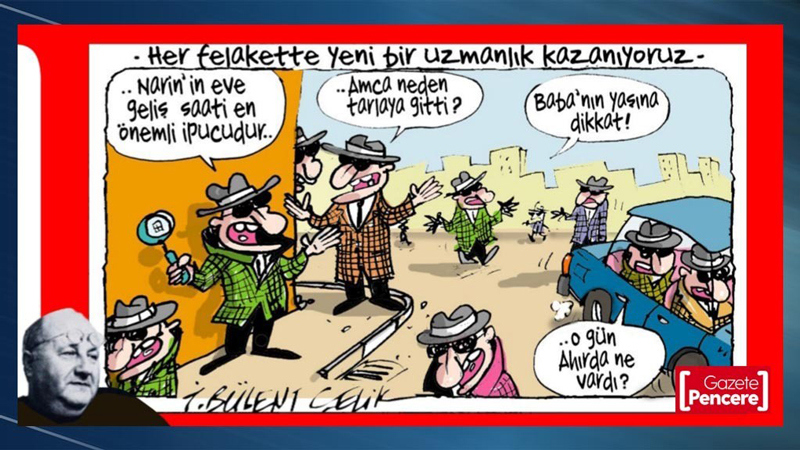
The headlines “Four scenarios in the Narin murder” in Hürriyet and “Here are those three possibilities” in Korkusuz were striking examples of journalists’ assumptions being mistaken for news. A journalist creates a scenario to untie the knot and find answers to questions. Then they investigate and try to find evidence. A scenario, just like claims or rumors, does not by itself constitute news as long as no evidence is found.
From the day Narin’s body was found, indeed from the first days of her disappearance, the mother, Yüksel Güran, was branded as “a woman living in an illegitimate relationship.” There are still those who speak of her relationship with uncle Salim Güran, who remains in pre-trial detention. For example, Sabah and AHaber published the statement of the detained Nevzat Bahtiyar as an “admission” confirming the relationship between the mother and the uncle. Yet no data has emerged so far to verify these relationship scenarios. On the contrary, her husband Arif Güran denied it; Narin’s DNA tests also did not confirm the scenarios about her father.
Still, on Didem Arslan Yılmaz’s program, sexual innuendos were made by writing that, on the days when Narin was being searched for, Yüksel Güran had “blood drawn with a syringe she brought with her from the nurses in the ambulance she called to her house, saying ‘The state wants it, a secret test will be done.’” Many outlets, from Cumhuriyet to Ekonomim, reported these under “allegation” headlines but with definitive expressions such as “it has emerged.”
Emotional exploitation is also at its peak. On Star and Show TV, news of Narin’s death and her funeral were presented with music like a film credit sequence. The main news bulletin presented by Ece Üner on Halk TV opened with a lament. On Now TV and some other channels, footage of Narin dancing at a wedding was aired together with the news of her death. Unfortunately, while trying to generate ratings, circulation and clicks off people’s grief, the traumatic impact is being deepened. Yet in news reports, “effects and music beyond the natural sound” should not be used, and archival footage should be selected in line with the content of the news.
TV100 reporter Canan Altıntaş crying on live broadcast and saying “I saw something, I cannot tell” was another example of turning journalism into a visual show. A journalist tells and writes what they know. If they cannot verify it and there is an ethical issue, they simply do not say that they have something they cannot tell. Moreover, she later explained that what she had seen was village women reciting prayers in front of a house before Narin’s body was found. In fact, it was not something that warranted such exaggeration.
Unfortunately, the zeal shown in relaying scenarios, allegations and possibilities was not shown in investigation. For example, it was written for days that “WhatsApp is not providing messages.” This continued until a reporter from DW called META officials and received the response, “We do not store messages, we do not have any messages to provide.” A journalist first investigates and then writes/tells, but in our media this rule has been reversed.
Of course, there were also journalists who pursued the truth, revealed concrete evidence and did successful work. In fact, the real progress was achieved thanks to them; they were the ones who informed the public.
The presumption of innocence also worked in reverse. First, everyone in the village was declared guilty in our media. Some journalists also preemptively decided and ruled that the murder had a political aspect. The evidence is only now beginning to emerge and the perpetrators are being identified; the scenarios that were produced are being refuted one by one.
The authorities bear a large share of responsibility in the emergence of this confusion of information. Even the Minister of the Interior, Ali Yerlikaya, preemptively declared the entire family guilty days before by saying, “Is it not very clear?” From the outset, the police, gendarmerie and prosecutor’s office did not establish a transparent channel to inform journalists. By preferring to provide information under the table, leaking the suspects’ statement texts, they encouraged rumor- and scenario-based journalism.
Nevertheless, I must say that the media’s embracing of Narin in this way and making her the main agenda item had a major effect on the progress made toward finding the killers. Had there been more care and a race in examples of investigative journalism, results could have been achieved more quickly.
THE JOURNALIST WHO PLAYED AN INTERVIEW ROLE
AKP Diyarbakır MP Galip Ensarioğlu stood out in this process as the person who voiced the most inappropriate statements at the most inappropriate times.
His remark to Sözcü TV about Narin’s killing, “There are things that we sometimes do not know, and sometimes know but must not say, because the family are our friends,” rightly drew criticism. While trying to correct his words by claiming he had been misunderstood, he again spoke to Sözcü TV. But this time his words became news as “AKP MP signals resignation.”
As a result, Ensarioğlu had to make yet another statement, saying that his words had been distorted and that he was not thinking of leaving politics. The most striking aspect of these developments in terms of journalism was the broadcast Sözcü made to defend its story.
Sözcü TV Ankara Bureau Chief Mehmet Bal appeared on screen and aired the audio recording of the telephone interview with Ensarioğlu[1]. However, as if a video interview were being conducted, they placed Ensarioğlu’s portrait on one side of the screen; on the other side, Mehmet Bal voiced the questions as though Ensarioğlu were actually in front of him at that moment and he were conducting a live interview. Incredibly, he acted on screen as a journalist, playing the role of the reporter conducting the interview! Meanwhile, the caption read “Ensarioğlu interview on Sözcü TV,” and viewers were not warned that this was a “re-enactment.”
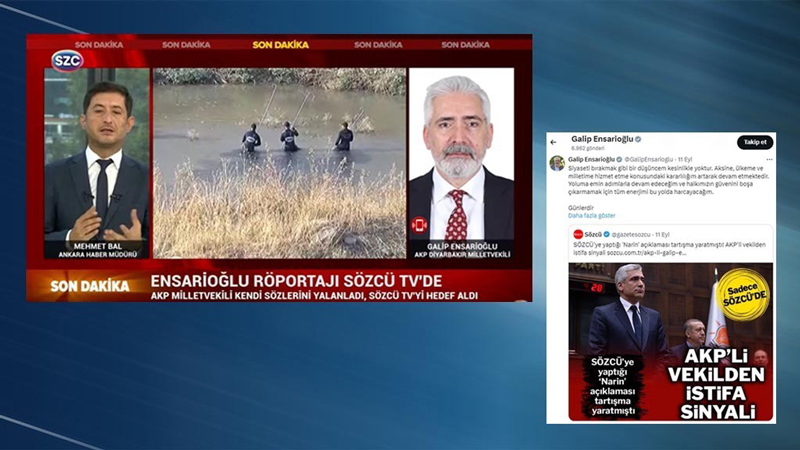
This is an extremely misleading style of reporting that distorts reality and is incompatible with journalism. First, a journalist does not act, does not add acting to the news, and there is no re-enactment in the news. An interview is what it is; you present it as is: if it is audio, it is audio; if it is video, it is video.
Second, when Ensarioğlu’s words are broadcast from a recording and Mehmet Bal’s questions are delivered through a re-enactment, it is impossible to be sure how faithfully the original form of the interview is reflected. For example, in a long question, Mehmet Bal tries to get Ensarioğlu to say that he is not blaming Sözcü TV; he ends one of his questions with the sentence, “You are saying that there was no distortion in the questions we directed, am I understanding correctly?” Ensarioğlu’s answer, however, does not directly correspond to this sentence.
The fact that technology allows it does not make it ethical to present a telephone interview as if it were a video interview on television. There may be no limits in technology, but there are limits in journalism; journalists, editors and presenters must internalize those boundaries.